


Plan on $1,075 to $1,525 for an open-trailer sedan that runs, from Ohio to Arizona, with roughly 5 to 8 days of transit after pickup. The 16 pairs we routed run 1,711 to 2,043 road miles. Reserve about two weeks ahead, and check the Arizona emissions rule if the car will be registered in the Phoenix or Tucson area.
How Does Car Shipping From Ohio to Arizona Work?
We routed four Ohio pickup cities, Cincinnati, Dayton, Toledo and Akron, against four Arizona delivery cities, Phoenix, Tucson, Flagstaff and Glendale. Those 16 pairs make ohio to arizona car shipping a run of 1,711 to 2,043 road miles, with Cincinnati to Flagstaff the shortest pair and Akron to Glendale the longest. In this spread the Ohio start sets more of the mileage than the Arizona city. For one Arizona address, the four Ohio starts differ by 193 miles, while from any one Ohio city the four Arizona cities spread across only 138 to 139 miles. By our routing, every pair shares one trunk: I-70 west to St. Louis, I-44 southwest to Oklahoma City, then I-40 west into Arizona. Only the lead-in changes. Cincinnati cars take I-74 to Indianapolis before joining I-70, Toledo cars come down I-69 from Fort Wayne, Akron cars take I-71 to Columbus first, and Dayton cars stay on I-70 from the start. The Arizona finish splits. Flagstaff cars ride I-40 all the way, Glendale cars turn south on I-17, and Phoenix cars drop south on AZ 260 and AZ 87. Tucson cars leave I-40 near Amarillo, cross New Mexico on US 60 and US 70, and finish on I-10.

What Does Car Shipping From Ohio to Arizona Cost?
Your quote depends on your vehicle, the exact pickup and delivery addresses, the season and the trailer type, so run the calculator for a figure on your dates.
Where the car starts in Ohio changes the mileage more than where it lands in Arizona. For one Arizona address, Dayton adds 5 to 6 miles over Cincinnati, Toledo adds 114 to 115 and Akron adds 193, which makes Akron the farthest start for every Arizona city.
The Arizona city matters less. From Cincinnati, Flagstaff is about 1,711 road miles, Tucson 1,774, Phoenix 1,807 and Glendale 1,850, a gap of 139 miles from the nearest city to the farthest. Phoenix sits 96 miles beyond Flagstaff from every Ohio start.
Mileage is only one input. A pickup or a full-size SUV takes more of the trailer than a sedan, and an enclosed trailer carries fewer cars, so each space costs more.
Send your pickup date and both street addresses, and we will price that exact lane.

A sedan that runs typically ships open from Ohio to Arizona for $1,075 to $1,525. Cincinnati and Dayton cars headed to Flagstaff sit toward the low end and Akron cars headed to Glendale toward the top. Enter both street addresses in the car shipping calculator for your own lane.
Pickups, vans and large SUVs usually add $100 to $200, since they take up more of the trailer. A vehicle that does not run must be winched aboard, which is billed separately. Choosing enclosed service adds roughly 40 to 60 percent to the price of each car.
- The Ohio start. Cincinnati is the nearest start for every Arizona city. For one Arizona address, Dayton adds 5 to 6 miles, Toledo 114 to 115 and Akron 193.
- The Arizona city. Flagstaff is the nearest end. Tucson adds 62 to 63 miles over Flagstaff, Phoenix 96 and Glendale 138 to 139, for the same Ohio start.
- The road out. Cincinnati cars use I-74 and then I-70, Toledo cars use I-69, Akron cars use I-71, and every pair then runs I-70, I-44 and I-40.
When one quote comes in far below the others, ask why. Drivers tend to pass on jobs that pay less than they expect, and the car can sit waiting.

What Factors Actually
Influence Pricing on This Route?
Five things move the price on any lane: the vehicle's size, whether it runs, how easy each end is to reach, the season and the trailer type. Booking early protects your timeline, keeps pricing steady and reduces the risk of last-minute carrier changes.


Type
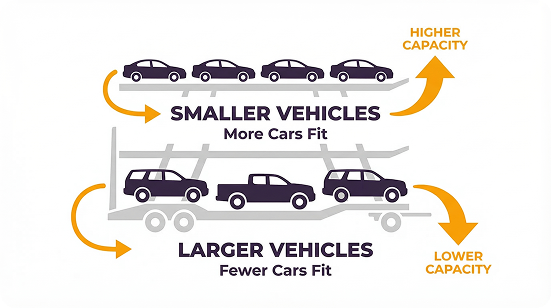
Size decides how much deck space your vehicle takes and how many other cars fit alongside it. A standard sedan is the cheapest thing to move because it slots almost anywhere on the trailer. SUVs, pickups and vans take more room and usually cost more on the same lane.


Is It Better to Drive Your Car or Ship It From Ohio to Arizona?
Loading It on a Carrier
By our routing, Cincinnati to Flagstaff is more than 30 hours at the wheel and Akron to Glendale more than 36, so even the shortest pair means several days on I-70, I-44 and I-40.
Shipping fits someone who has to report to a job in Arizona by a set date, or a family moving two cars with only one driver available.
Driving It Yourself
Driving can work if you have the days to spare. Cincinnati to Flagstaff, our shortest pair at about 1,711 miles, is about 30 hours of driving by our routing, and Akron to Glendale at about 2,043 miles runs past 36.
Count the trip home as well. Whoever drives the car out must still return to Ohio, and a one-way flight, fuel and several hotel nights add up.
How Long Does Ohio to Arizona Car Shipping Take?
After loading, transit to Arizona typically runs 5 to 8 days. Cincinnati to Flagstaff, our shortest pair at about 1,711 miles and 30 hours of driving, may arrive near the early end, while Akron to Glendale, about 2,043 miles and 36 hours, may use more of the range.
Before pickup, dispatch has to line up a licensed carrier, which commonly takes one to three working days, so leave the pickup window open if you can.
Winter ice on I-70 or I-44, snow on I-40 near Flagstaff, a crowded delivery schedule on the truck and Phoenix traffic can each add a day.
When Should You Book Ohio to Arizona Car Shipping?
Book about two weeks before the pickup date, with one week as the floor, so dispatch can slot your car onto a truck already rolling west on I-70. A single fixed pickup day shrinks the pool of trucks, so say so if your date has any give.
The cross-country timing guide explains why long hauls arrive early or late. Another lane that begins in Ohio is the Ohio to Florida route.
Open or Enclosed Transport for an Ohio to Arizona Car?
Most cars on this corridor ride open transport, a two-deck trailer with no walls or roof, so the car meets the same weather on I-40 that any other traffic does.
Enclosed transport wraps the car in walls and a roof from pickup to drop-off. These trailers hold fewer cars, which is why a space costs roughly 40 to 60 percent more.
A show car, fresh paint or a low sports car can justify that premium. A daily-driver sedan from Dayton to Phoenix usually does fine on an open trailer.
Enclosed Car Transport
Enclosed demand rises for high-value, specialty and seasonal vehicles, and enclosed trailers protect against road debris and weather, which matters most on longer hauls. Enclosed rigs are a small fraction of the trailers working any given lane, and that scarcity is what drives both the higher price and the longer booking lead time.
Open Car Transport
Most vehicles move on open trailers, and for most routes that is the more cost-effective way to ship a car.
Open transport works well for standard vehicles and keeps costs predictable. It also offers the widest carrier availability.
Does a Car From Ohio Need an Emissions Test in Arizona?
While the car is in transit, you can read the Arizona Department of Environmental Quality page on emissions testing. The facts below come from that page as read on 17 November 2026.
- Where testing applies. The page says testing is required in the Phoenix and Tucson metropolitan areas, which it describes as areas not meeting federal air quality standards for ozone and other pollutants.
- What the page does not cover. It does not say how the rule applies to a car that is new to Arizona, and it lists no model-year exemptions. Confirm both with the Arizona Motor Vehicle Division before you plan the registration.
Source: Arizona Department of Environmental Quality, Emissions Testing Is Essential.
Where Will the Carrier Meet You in Ohio and Arizona?
Settle the pickup spot with dispatch before the truck is assigned. The transporter has to stop and lower its ramps, so a wide road or an empty parking area works better than a tight dead end.
In Ohio, older Cincinnati and Akron blocks with narrow streets or low branches can trouble a long truck, so a lot near the highway may be easier. In Arizona, big apartment complexes and gated communities around Phoenix, Glendale and Tucson can stop the truck short of your door, and the handoff then moves to a nearby lot. The state pages for both ends are Ohio car shipping and Arizona car shipping.
Before signing, check that the bill of lading records every mark you and the driver find at pickup and again at delivery. Photograph all sides in advance and empty the cabin of loose items.
What Is Worth Knowing Before You Book Ohio to Arizona Auto Transport?
Rivalane, a broker based in Melville, New York, takes each order on this lane and assigns a licensed carrier. Tracking opens once the car is loaded. Tell us the Ohio pickup city when you request a quote, since that choice moves the mileage the most.
Frequently Asked Questions