Registering an out-of-state car in Kentucky takes three things in a fixed order: a Kentucky insurance policy, an inspection by a certified inspector designated by the county sheriff, and a visit to the county clerk for the title, the registration and the usage tax. Kentucky law gives you 15 days after you bring the car into the state, and the Transportation Cabinet asks new residents to finish within 10. This guide follows the steps for a car you already own, using a car shipped from New York as the example, and covers what changes when a Kentucky resident buys a car in another state. If the car still has to make the trip, Rivalane coordinates door to door transport with licensed, insured carriers, and our page on shipping a car from New York to Kentucky covers the lane.
How Long Do You Have to Register a Car in Kentucky?
Fifteen days. Under KRS 186.020, a person who brings a motor vehicle into Kentucky from another state must apply for registration within 15 days, with the county clerk of the county where they live, and the application has to include proof that the car is insured as Kentucky law requires.
The Transportation Cabinet's New to Kentucky page sets a shorter target: it tells new residents to title and register their vehicles within 10 days of establishing residency, and to get a Kentucky driver's license within 30 days. Treat 10 days as the goal and 15 as the legal limit. Because the statute's clock starts when the car comes into the state, line up the insurance and the inspection before it arrives.
What Order Do the Steps Go In?
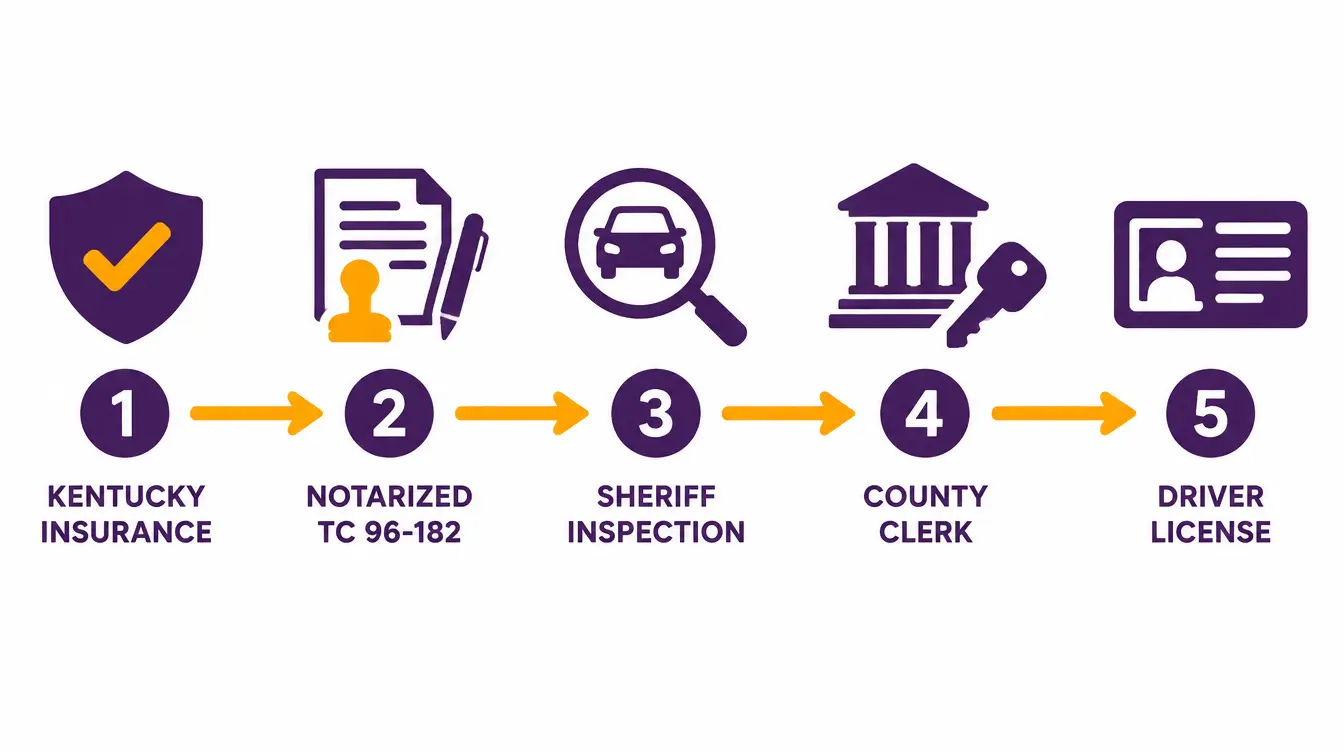
Each step needs something from the one before it, so the order matters. For a car you own and are bringing from New York, it runs like this:
- Buy a Kentucky insurance policy. The clerk will not title the car without proof of Kentucky coverage.
- Fill in form TC 96-182 and have it notarized. This is the Application for Kentucky Certificate of Title or Registration, and the signatures on it must be notarized.
- Get the sheriff's inspection. Take the car and the notarized TC 96-182, with its supporting documents, to a certified inspector in the county where you will file.
- Visit the county clerk. The title, the registration, the plates and the usage tax are all handled there.
- Get your Kentucky driver's license within 30 days of moving.
The insurance step is the one most often misread. The Transportation Cabinet asks for proof of Kentucky insurance with an issue or effective date within 45 days, and its New to Kentucky page sets the minimum liability coverage at $25,000 per person and $50,000 per accident for bodily injury and $25,000 for property damage, or a single limit of $60,000. You may see it said that the policy has to be active for 45 days before you register. The official pages describe how recent the proof must be, not a waiting period, so you can buy the policy and visit the clerk soon after.
What Does the Kentucky Vehicle Inspection Check?
Every car brought into Kentucky from another state needs a passed sheriff's inspection before the clerk will title it, and the inspection is about the car's identity, not its mechanical condition. Under KRS 186A.115, a certified inspector designated by the county sheriff compares the vehicle identification number plate and the federal safety standards label with your title application and its supporting documents, and records the odometer reading.
The statute sets the fee at $15 for an individual, or $20 when the inspector travels to the car, and historic vehicles get a VIN verification only. Do the paperwork first. A Kentucky county clerk's office notes that the sheriff will not inspect the car until the TC 96-182 has been signed and notarized, so arrive with the completed form.
What Documents Does the County Clerk Need?
The Transportation Cabinet's Vehicle Titling page lists what to bring to the county clerk's office for an out-of-state vehicle:
- Form TC 96-182, completed, signed and notarized.
- The original out-of-state title. If your previous state issues only a registration or a bill of sale, bring that instead.
- Proof of Kentucky insurance, dated within the last 45 days.
- Identification: a Kentucky driver's license, a Kentucky ID card or your Social Security card.
- Proof of the passed sheriff's inspection.
- A name affidavit if the name on the title differs from the name on your ID. A marriage license or divorce decree is the example the page gives.
Add proof of the tax you paid in your previous state if you want the usage tax credit, covered below. The ID rule is also why the license can come last: a Social Security card is accepted at the clerk's counter, so you do not need your Kentucky license to title the car.
What If a Lender Holds Your Title?
You can still register the car. The Vehicle Titling page says the county clerk may request the title from your lender, and that Title Lien Statements go to the county clerk's office that processes your title and registration.
Kentucky county clerk offices explain what happens in the meantime. Once you show proof of Kentucky insurance and your current out-of-state registration, the clerk can issue a 30-day temporary plate while the title is on its way. Because Kentucky is not a title-holding state, the Jefferson County Clerk's office says the new Kentucky title showing the lien is mailed to the owner rather than kept by the lender.
That makes the New York registration worth keeping valid until you have Kentucky plates, because clerk offices ask for it before they issue the temporary plate.
How Does Kentucky Usage Tax Work for a Car You Already Own?
Kentucky charges a 6 percent motor vehicle usage tax when a vehicle is offered for registration in the state for the first time. The county clerk collects it, and the Department of Revenue says a clerk cannot register the car or issue plates until it is paid, along with the title and registration fees.
New residents get a credit. When the car was registered in a state that levied a tax substantially identical to Kentucky's, the Department of Revenue credits the tax you paid there against the 6 percent, as long as that state gives a similar credit for Kentucky tax. Its FAQ names Georgia as the exception, for tax paid there after March 1, 2013.
The Department of Revenue accepts three kinds of proof of tax paid:
- Registration documentation from your previous state.
- The title from that state, if it clearly shows the tax paid.
- The purchase contract, if it clearly shows the tax paid and lists the buyer, the seller and the vehicle. It goes in with the TC 96-182. Finance contracts are not accepted.
If you cannot document the tax, Kentucky county clerk offices describe a presumed credit for a car titled in the same name, which also requires proof of current registration from the other state. That is one more reason to keep the New York registration active until the clerk visit.
What Other Fees and Taxes Come With Registration?
At the same visit, the clerk collects the title and registration fees and, when a lender is involved, a lien filing fee. Accepted forms of payment vary by county, so check with your county clerk's office before you go. If you want the new title mailed sooner, the Vehicle Titling page offers a speed title for $25, mailed the next business day.
Kentucky also taxes vehicles as property every year. The Department of Revenue's motor vehicle property tax page says county property valuation administrators assess vehicles as of January 1, that whoever owns a car on January 1 owes that year's tax, and that it is paid to the county clerk where the car is registered. For a car already registered in Kentucky, the Department mails a notice of tax due and registration renewal in the month before your renewal month, which is usually your birth month, and the Transportation Cabinet says most of these property taxes are due by the last day of your birth month.
Bought the Car in Another State?
This part is for Kentucky residents who buy a car out of state and bring it home. KRS 186.020 gives anyone who buys a motor vehicle the same 15 days to apply for registration, and the bill of sale or assigned title has to stay in the car during that time.
Before the car leaves the seller, sort out three things:
- The title assignment. The seller signs the title over to you before the car is loaded.
- A notarized affidavit of total consideration. The Department of Revenue taxes a used car on the price shown on Form 71A100, or the total consideration section of TC 96-182, and its FAQ says the affidavit is notarized by both the seller and the buyer. Without it, the clerk uses retail value from the NADA guide. Get the seller's notarized signature before the car leaves, because the seller will be far away when you title it. Sellers can follow our guide to selling a car to an out-of-state buyer for their side of the paperwork.
- The trip home. The Transportation Cabinet does not issue transit tags to Kentucky residents bringing an out-of-state purchase home, and it points to the seller's state for temporary registration. A car shipped on a carrier is not driven on public roads until it reaches you.
When the car arrives, it needs the same sheriff's inspection. Ask the sheriff's office whether the inspector can come to the car, since the statute sets a $20 fee for that. The clerk then collects the 6 percent usage tax, less any credit or exemption that applies. Buying from a New York dealer? Form DTF-820 decides whether New York charges sales tax, and only a buyer who meets every one of its conditions qualifies. Our guide to buying from a dealer in New York as a nonresident covers the form.
When Do You Need a Kentucky Driver's License?
Within 30 days of establishing residency, according to the New to Kentucky page. You apply in person at a Driver Licensing Regional Office, and with a valid out-of-state license you do not take the tests. An eight-year standard license costs $43 and an eight-year REAL ID license $48. The same page lists the documents to bring, so check it before your visit.
Students and Military Members
Students. The New to Kentucky page lets a U.S. citizen enrolled as a full-time or part-time student at a Kentucky college, university or technical college drive on a valid out-of-state license with a student identification card.
Active-duty military. The Transportation Cabinet's Vehicle Registration page accepts out-of-state insurance when the owner is on active duty and listed on the vehicle title, and lists an active military ID, a letter from the Provost Marshal and an LES (pay stub) as acceptable proof. The 45-day date rule on insurance proof does not apply to military policies. On property tax, the Department of Revenue says a service member in Kentucky on military orders does not owe Kentucky vehicle property tax unless the LES shows Kentucky as the state of residence or taxable state.
What About Your New York Plates and Registration?
Keep them until Kentucky has registered the car. The New York registration can be your proof of tax paid for the usage tax credit, it is what county clerk offices ask to see for a presumed credit, and it is part of what they need before issuing a 30-day plate while a lender sends the title. Once the car has Kentucky plates, return the New York plates to the New York DMV, and cancel the New York policy only after that. Our guide to handing back New York license plates covers the PD-7 form and the FS-6T receipt.
Still planning the move? Our page on car shipping in Kentucky covers pickups and deliveries across the state, and the car shipping calculator prices the trip.
Frequently Asked Questions
How long do I have to register a car in Kentucky after moving?
Does Kentucky have a vehicle inspection for cars from another state?
Do I pay Kentucky usage tax if I already paid sales tax in another state?
Can I register a car in Kentucky if my lender has the title?
Do I need Kentucky insurance before I register the car?