


Los Angeles to Richmond is about 2,620 miles, mostly on I-40, and the car typically arrives 6 to 9 days after it is loaded. Booked on an open carrier, a running sedan typically lands between $1,200 and $1,700. Plan two to three weeks ahead, and insure the car in Virginia before registering it.
How Does a Car Travel From California to Virginia?
California to Virginia car shipping runs about 2,264 to 2,990 road miles, judging by the 64 pairs of towns we mapped, and the California pickup city decides which of three roads the carrier takes. Cars from Los Angeles, Riverside, Irvine and Fresno head out past Barstow on I-40 and stay on it through Flagstaff, Albuquerque, Amarillo, Oklahoma City, Little Rock, Memphis and Nashville to Knoxville, where I-81 climbs into southwest Virginia. San Diego loads cross southern Arizona and Texas by Tucson, El Paso and Dallas and meet that same line at Little Rock. Every Sacramento load, along with San Francisco cars bound for most of Virginia and San Jose cars bound for Arlington or Winchester, goes the northern way instead, east on I-80 by Reno, Salt Lake City, Cheyenne and Lincoln. In Virginia, every Richmond, Charlottesville, Norfolk and Virginia Beach delivery we routed passes Staunton on I-64, while Roanoke and Bristol sit right on I-81. On the core pair, Los Angeles to Richmond, the road distance is about 2,620 miles.

What Does It Cost to Ship a Car From California to Virginia?
Your quote depends on your vehicle, the exact pickup and delivery addresses, the season and the trailer type, so run the calculator for a figure on your dates.
Most of the spread on this lane comes from the two ends rather than the road between them. Measured to Richmond, Riverside is the nearest California pickup in our sample at about 2,585 road miles, Irvine, Los Angeles and San Diego sit near 2,620 to 2,640, Fresno is about 2,744 and Sacramento about 2,797, while San Jose and San Francisco run near 2,880. Our California car shipping guide lists more pickup areas.
The Virginia address moves the mileage almost as much. From Los Angeles, Bristol is about 320 miles shorter than Richmond and Roanoke about 175 shorter, while Arlington adds about 57 and Virginia Beach about 107. The Virginia car shipping page covers delivery areas across the state.
A carrier filling its deck for a planned eastbound run is what keeps a price inside the usual range. A very low quote often means the order waits until some driver accepts that rate, so the cheapest number is rarely the quickest pickup.
Flexible pickup days help as well, since dispatch can then weigh more of the trucks already leaving California.

For a sedan that runs, open-carrier quotes from Los Angeles to Richmond usually sit between $1,200 and $1,700 at the moment, and Bay Area, Sacramento and Fresno pickups tend to price toward the top of that range. For a number tied to your exact towns and dates, try the car shipping calculator.
Because full-size SUVs, minivans and pickups take a bigger share of the deck, they generally cost $100 to $200 more. On an enclosed trailer, expect a quote that typically runs 40 to 60 percent over open.
Three things move a quote inside that range:
- Pickup city. San Francisco and San Jose sit nearly 300 miles farther from Richmond than Riverside does, so Bay Area pickups usually cost more.
- Delivery city. Bristol and Roanoke come well before Richmond on the road from Los Angeles, while Hampton Roads deliveries run about 90 to 110 miles past it.
- Season. Winter weather on I-80 and in the high country along I-40 can stretch schedules, and flexible pickup days help most in those months.

What Factors Actually
Influence Pricing on This Route?
Five things move the price on any lane: the vehicle's size, whether it runs, how easy each end is to reach, the season and the trailer type. Booking early protects your timeline, keeps pricing steady and reduces the risk of last-minute carrier changes.


Type
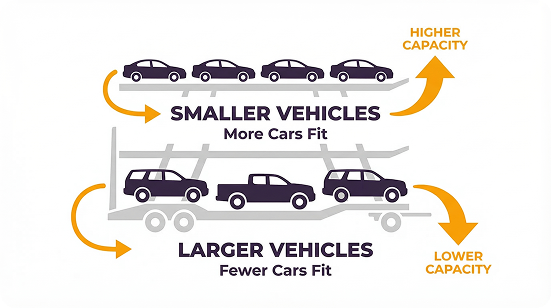
Size decides how much deck space your vehicle takes and how many other cars fit alongside it. A standard sedan is the cheapest thing to move because it slots almost anywhere on the trailer. SUVs, pickups and vans take more room and usually cost more on the same lane.


Is It Better to Ship or Drive a Car From California to Virginia?
Why Ship It
Shipping makes sense when the moving date is set and a week of driving will not fit, when there are two cars and one driver, or when nobody wants winter driving across the high desert and the western passes.
It also spares the car roughly 2,600 miles of wear and the household a week of fuel, meals and hotels.
Why Drive It
Two drivers who are not tied to a delivery date can sometimes do the trip for less, and that is worth saying. Our routing puts Los Angeles to Richmond at about 46 hours behind the wheel, which with sleep and meals usually becomes six or seven days.
Even the shortest pairing we measured, Riverside to Bristol, is about 2,264 miles. If you are weighing the two, the cost of shipping a car cross-country explains what goes into each option.
How Long Does Car Shipping From California to Virginia Take?
Once the car is loaded, most California cars typically reach Virginia in 6 to 9 days. The short end of that range fits pairings like Riverside to Bristol, which we measured at about 2,264 miles, while a San Francisco to Virginia Beach load covering about 2,990 miles may need the full nine days.
Before any of that, allow one to three working days while Rivalane assigns the carrier. Offering a spread of pickup dates instead of one fixed day widens the pool of eastbound trucks dispatch can consider.
Our routing puts the Los Angeles to Richmond drive at about 46 hours, with the halfway point a little west of Oklahoma City. Winter storms can slow the I-80 loads in Wyoming and the Sierra, and snow sometimes reaches I-40 in the high country of northern Arizona and New Mexico.
When Should You Book Car Shipping From California to Virginia?
Booking two to three weeks out is a good target. It lets Rivalane hold out for a licensed carrier that already has an eastbound trip scheduled and space left on its trailer, instead of settling for whichever truck frees up first.
For December through March pickups, and above all for Sacramento and Bay Area loads on I-80, leave a few spare days in the plan.
Going the other way? Virginia to California car shipping covers the westbound trip. Delivering elsewhere in the East? See California to North Carolina car shipping or California to New York car shipping.
Should a California to Virginia Car Go Open or Enclosed?
Open car transport suits most cars on this lane, which ride a two-level carrier alongside other vehicles. Over some 2,600 miles it sees the same sun, rain and road dust a driven car would, from the Mojave Desert to the Virginia mountains.
Enclosed car transport shuts the car inside a hard-sided box from the pickup curb to the delivery curb, out of the weather and the flying grit. With room for only a handful of cars, those trailers price each slot higher and book up sooner when dates are tight.
Collector cars, exotics and anything with new paint tend to travel enclosed, while commuter cars generally go open.
Enclosed Car Transport
Enclosed demand rises for high-value, specialty and seasonal vehicles, and enclosed trailers protect against road debris and weather, which matters most on longer hauls. Enclosed rigs are a small fraction of the trailers working any given lane, and that scarcity is what drives both the higher price and the longer booking lead time.
Open Car Transport
Most vehicles move on open trailers, and for most routes that is the more cost-effective way to ship a car.
Open transport works well for standard vehicles and keeps costs predictable. It also offers the widest carrier availability.
What Virginia Asks of a Car Arriving From California
Some of what Virginia asks applies anywhere in the state, some only in Northern Virginia, and a little depends on your city or county. The Virginia DMV lists each step on its New to Virginia page.
- Anywhere in Virginia. You have 60 days from the move to get a Virginia driver license, and 30 days to title the car and to register it at a DMV customer service center. Keep at least the minimum liability insurance on it, and put that coverage in place before you register, as the DMV advises. The car also needs to pass the annual Virginia safety inspection and carry a valid sticker, and most repair shops in the state do the inspection.
- Northern Virginia. An emissions inspection applies too when the car is kept in the counties of Loudoun, Stafford, Arlington, Prince William and Fairfax, or in Manassas Park, Falls Church, Alexandria, Manassas and the City of Fairfax.
- Your city or county. Some localities ask new residents to buy a local sticker or decal within 30 days of moving in, so check with the local government where the car will be kept.
Source: Virginia DMV, New to Virginia.
What to Expect at Pickup in California and Delivery in Virginia
Pick the meeting spots for both ends when you book. A full two-level carrier needs flat, open pavement to lower its ramps and turn back into traffic, which rules out many residential streets.
On the California side, hillside streets above Los Angeles, the slopes of San Francisco, gated Irvine neighborhoods and short cul-de-sacs in new tracts often move the handoff to a grocery store lot or a wide main road around the corner.
In Virginia, newer neighborhoods in the Richmond suburbs and around Roanoke usually have room, while the narrow, tree-lined streets of older Richmond and Norfolk neighborhoods and the dense blocks of Arlington and Alexandria more often mean a handoff in a parking lot a block or two away.
The driver checks the car over with you at both handoffs, writing any existing scratches or dents onto the bill of lading. Your own dated pictures of all four sides, taken before loading, make it easy to compare its condition with that report before you sign for it in Virginia.

Key Things to Know Before Shipping a Car From California to Virginia
Rivalane coordinates this lane from Melville, New York: your car is paired with a licensed carrier on a scheduled eastbound run, and real-time tracking stays available until delivery. Line up Virginia insurance before the car arrives, since the Virginia DMV advises insuring a car before registering it, and the title and registration both fall due within 30 days of the move.
Frequently Asked Questions