




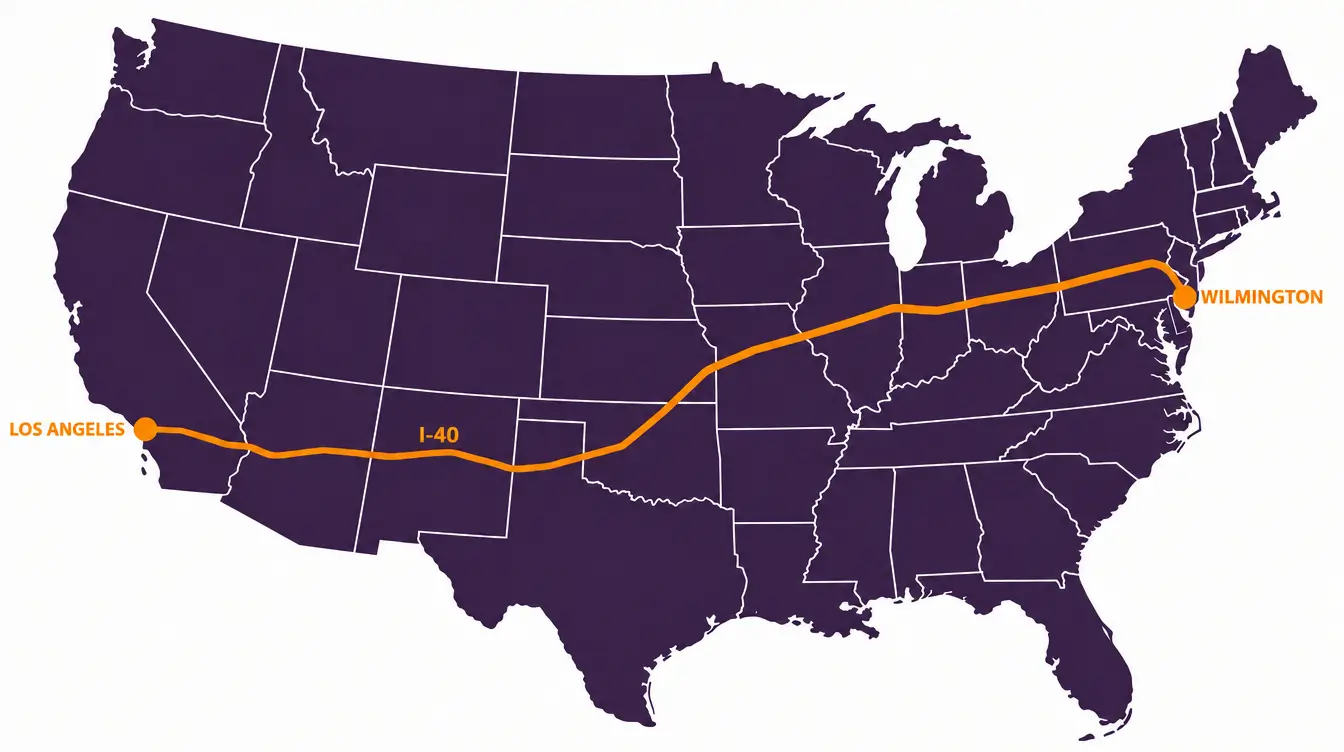
Wilmington to Los Angeles runs about 2,707 miles on I-40, usually 6 to 9 days after pickup, and a running sedan on an open carrier typically costs $1,200 to $1,700. Bay Area and Sacramento cars take I-80 instead. Book two to three weeks ahead, and return the Delaware plate before canceling its insurance.
How Does a Delaware Car Get to California?
Delaware to California car shipping covers about 2,655 to 2,939 road miles depending on the towns, judging by the 64 pairs we mapped, and because Delaware is small, the California address decides the road far more than the pickup town does. Every San Jose, San Francisco and Sacramento load joins I-80 and runs west through Iowa, Nebraska, Wyoming, Utah and Nevada, by way of Omaha and Salt Lake City. Southern California and Fresno loads split at the Delaware end. Cars from Wilmington, Newark, Middletown and Smyrna head west to pick up I-70 by Wheeling, Columbus and Indianapolis to St. Louis, then follow I-44 past Tulsa onto I-40 for Amarillo, Albuquerque and Flagstaff. From Dover south through Milford, Georgetown and Seaford, carriers reach I-81 instead and ride it down past Roanoke before I-40 takes them through Knoxville, Nashville, Memphis, Little Rock and Oklahoma City. San Diego adds one more wrinkle: from Middletown southward, our routing leaves I-40 at Little Rock and crosses Texas by Dallas and El Paso before I-10 runs west.
What Does It Cost to Ship a Car From Delaware to California?
Your quote depends on your vehicle, the exact pickup and delivery addresses, the season and the trailer type, so run the calculator for a figure on your dates.
Most of the price spread on this lane comes from the California end. Measured from Wilmington, Riverside comes in closest of the eight California cities we checked, at about 2,673 road miles, Irvine and Los Angeles follow at roughly 2,705, San Diego is near 2,728 and Sacramento about 2,785, while Fresno, San Francisco and San Jose run from about 2,831 to 2,903. Other delivery areas appear on the California car shipping page.
The Delaware end matters much less. Newark sits about 17 miles closer to Los Angeles than Wilmington does, while Middletown, Smyrna, Dover, Milford, Seaford and Georgetown add between 31 and 69 miles. For a pickup elsewhere in the state, start with the Delaware car shipping page.
Beyond distance, the footprint of the vehicle, open or enclosed service and the month you book set the rest, because the season changes how many westbound carriers still have a slot open.
Moving a running sedan from Wilmington to Los Angeles on an open carrier typically runs $1,200 to $1,700, and Bay Area, Sacramento and Fresno deliveries tend to sit toward the top of that range. For your exact towns and dates, the car shipping calculator has a figure.
Pickups, minivans and full-size SUVs take up more deck room and generally add $100 to $200. An enclosed trailer usually pushes the quote 40 to 60 percent past open.
Three things move a quote around inside that range:
- Delivery city. San Francisco and San Jose sit roughly 200 to 230 miles beyond Riverside, the closest of the California cities we measured.
- Where in Delaware. Sussex County pickups in Georgetown and Seaford add about 60 to 70 miles over a Wilmington start, which barely shows on a trip this long.
- Month of the year. Winter storms on I-80 through Wyoming and the Sierra Nevada can hold up northern California loads, and quieter months leave dispatch more trucks to pick from.

What Factors Actually
Influence Pricing on This Route?
Five things move the price on any lane: the vehicle's size, whether it runs, how easy each end is to reach, the season and the trailer type. Booking early protects your timeline, keeps pricing steady and reduces the risk of last-minute carrier changes.


Type
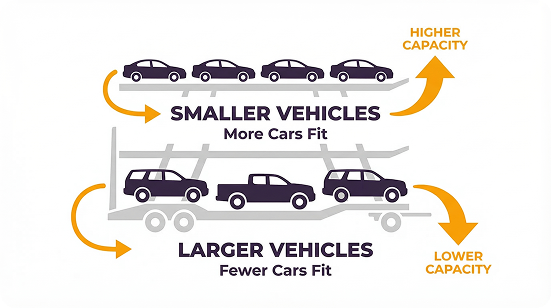
Size decides how much deck space your vehicle takes and how many other cars fit alongside it. A standard sedan is the cheapest thing to move because it slots almost anywhere on the trailer. SUVs, pickups and vans take more room and usually cost more on the same lane.


Is It Better to Ship or Drive a Car From Delaware to California?
Reasons to Ship
Shipping makes sense when a California job or lease starts before a week on the road can fit in, when a family is moving more cars than it has drivers, or when nobody wants winter weather on the western mountain passes.
It also keeps roughly 2,700 miles of wear off the car and skips a week of gas, restaurant meals and motel bills.
Reasons to Drive
Two drivers with a flexible arrival date can sometimes drive for less, and we would rather say so. Our routing puts Wilmington to Los Angeles at about 48 hours of driving, and with sleep and meals that usually stretches to six or seven days.
Alone, the trip is long from any corner of Delaware, since even Newark to Riverside measures about 2,655 miles. The cross-country car shipping cost breakdown puts driving and shipping side by side.
How Long Does Car Shipping From Delaware to California Take?
After loading, most Delaware cars typically reach California in 6 to 9 days. Short pairings such as Newark to Riverside, about 2,655 miles in our routing, often arrive early in that window, and a Georgetown to San Jose run of about 2,939 miles can take all of it.
Before that, assigning a carrier usually needs one to three working days. Naming a range of pickup days lets dispatch consider more of the trucks heading west than a single date would.
Our routing has the Wilmington to Los Angeles drive at about 48 hours, with the midpoint a little east of Oklahoma City. Winter snow in Wyoming and on the Sierra passes can slow the I-80 loads, and the I-40 stretch across the New Mexico and Arizona high country gets the occasional storm as well.
When Should You Book Car Shipping From Delaware to California?
Plan on two to three weeks of lead time. With that much notice, Rivalane can hold out for a licensed carrier with a California run already planned and a free spot on the deck, instead of taking whatever truck is free first.
For December through March pickups, and especially Bay Area or Sacramento deliveries, allow a few spare days, since winter can slow the northern route.
Shipping from just across the state line? See Maryland to California car shipping or New Jersey to California car shipping. Heading south instead? Delaware to Florida car shipping covers that run.
Should a Delaware to California Car Go Open or Enclosed?
Open car transport is the standard pick on this lane, with the car riding a two-level carrier alongside others. Across nearly 2,700 miles it meets the same weather and road grit a driven car would, from Midwest spray to Southwest dust.
Enclosed car transport keeps the car behind the walls and roof of a hard-sided trailer from pickup to delivery, out of the rain, dust and flying debris. Those trailers hold fewer cars, which makes each spot pricier and short-notice dates harder to fill.
Collector cars, exotics and anything freshly painted usually travel enclosed, while daily drivers generally go open.
Enclosed Car Transport
Enclosed demand rises for high-value, specialty and seasonal vehicles, and enclosed trailers protect against road debris and weather, which matters most on longer hauls. Enclosed rigs are a small fraction of the trailers working any given lane, and that scarcity is what drives both the higher price and the longer booking lead time.
Open Car Transport
Most vehicles move on open trailers, and for most routes that is the more cost-effective way to ship a car.
Open transport works well for standard vehicles and keeps costs predictable. It also offers the widest carrier availability.
The Numbers Behind Registering a Delaware Car in California
Moving a Delaware car onto California registration comes down to a handful of figures, most set by the California DMV and the last two by Delaware.
- 20 days. The clock on registration runs 20 days, starting from the day you take up residence or the day the car is brought into California. Filing on time with the fees paid, even with a paper still outstanding, is what the DMV recommends to stay clear of penalties.
- Six months. Residency, for the DMV, begins once you plan on living in the state at least six months out of the year, and other ties to California can count too.
- Two forms. Each registered owner signs the REG 343 form, which is the title or registration application. The REG 31 vehicle verification can be done by a law enforcement officer, by a licensed California verifier or by an authorized DMV employee. Take along the most recent Delaware title and registration card as well, because without the title California issues no title of its own and marks the registration card nontransferable.
- 1976 and 1998. A California smog certificate is required for gasoline cars built in 1976 or later and for diesels built in 1998 or later that weigh under 14,001 pounds gross. Motorcycles are exempt.
- 7,500 miles. If the car was less than 2 years old and had under 7,500 miles when you bought it, California generally will not register it unless it was certified to California emission standards when new or an exemption covers it.
- One plate, back to Delaware. California lets you keep plates that the issuing state wants returned, and Delaware does: the plate goes back to the Delaware DMV with a statement that the car is now registered in California, in person or by mail to its Uninsured Motorist Section in Dover.
- Zero days uninsured. Delaware requires liability insurance while a registration is valid and asks for the plate to be surrendered before the policy is canceled, so keep the Delaware coverage until the plate is in.
Our California DMV guide for cars from other states walks through the visit itself, and the DMV lays out the full process in its New California Resident Portal.
What to Expect at Pickup in Delaware and Delivery in California
Settle the pickup and delivery spots while the order is being set up. Because a loaded carrier runs long and heavy, the driver needs a wide, level stretch of road or a lot where the ramps can come down and the truck can pull away without blocking traffic.
In Delaware, newer subdivisions around Middletown, Smyrna and Dover usually have room. Older rowhouse streets in Wilmington, packed summer streets in Lewes and Rehoboth Beach and narrow farm roads in Sussex County more often push the meeting to a grocery store lot or a through road nearby.
In California, steep streets in the Los Angeles hills and in San Francisco, gated communities in Orange County and tight cul-de-sacs in newer Central Valley developments can move the meeting to a larger lot close by.
At loading, walk the car with the driver and make sure every existing chip, scratch and dent ends up on the condition report, then sign once the two of you agree on it. When the car rolls off the trailer in California, hold it up against that report before you sign for delivery.
Key Things to Know Before Shipping a Car From Delaware to California
Rivalane coordinates Delaware to California shipments from its Melville, New York office, placing each car with a licensed carrier already bound west and keeping real-time tracking available through delivery. Sort out the plate early: registration in California is due within 20 days, and Delaware wants its plate back, with a statement that the car is now registered in California, before the insurance on it can be canceled.
Frequently Asked Questions