


Sixteen pickup and drop pairs, 830 to 1,552 miles long, make up this lane. Shipping an open-carrier sedan from Idaho to Arizona costs about $850 to $1,100, and transit for most loads takes 4 to 6 days. Picking a different Idaho town can change the mileage by up to 470; picking a different Arizona town, by up to 253.
How Does a Car Get From Idaho to Arizona on the Road?
This page treats Idaho to Arizona car shipping as sixteen measured pairs built from four Idaho pickup towns, Caldwell, Jerome, Rexburg and Post Falls, and four Arizona drop towns, Chino Valley, Cave Creek, Coolidge and Willcox. Jerome to Chino Valley is the shortest pair at 830 miles and Post Falls to Willcox the longest at 1,552. Caldwell loads run I-84 for 328 miles into northern Utah and Jerome loads run it for 188, and both then take I-15 for 245 miles. Rexburg loads cover 26 miles on US-20 and then 425 on I-15. Post Falls loads leave the panhandle east on I-90 for 285 miles through Montana and then follow I-15 for 623 miles, which is why they run about 470 miles longer than Jerome loads. Every start joins US-89 for 279 miles into Flagstaff. From there Cave Creek loads take I-17 for 114 miles, Coolidge loads take I-17 for 157 and I-10 for 23, and Willcox loads take I-17 for 157 and I-10 for 175. Chino Valley loads turn west on I-40 for 54 miles and finish on AZ-89 for 35. To keep the Caldwell and Jerome pairs on interstates, the router was given a stop at Salt Lake City; without it, those pairs cut across Nevada on more than 500 miles of US-93 and SR-318. A carrier may choose different roads.

Does the Idaho Start or the Arizona Drop Move the Miles More?
Your quote depends on your vehicle, the exact pickup and delivery addresses, the season and the trailer type, so run the calculator for a figure on your dates.
On this lane the Idaho start town carries far more weight than the Arizona drop town. Whichever Arizona town you pick, the four Idaho towns line up in the same order: Jerome is shortest, Rexburg runs 12 or 13 miles longer, Caldwell 138 or 139 longer and Post Falls 469 or 470 longer.
With the start fixed, the Arizona town matters much less. From Jerome, Chino Valley is 830 miles, Cave Creek 874, Coolidge 943 and Willcox 1,082, a spread of 252. From Post Falls the same four towns run 1,299 to 1,552, a spread of 253.
Two small steps repeat for every start: Cave Creek sits 43 or 44 miles past Chino Valley, and Coolidge sits 113 or 114 past it. Post Falls is the long outlier because its loads cross Montana on I-90 and I-15 before they ever reach Utah. Vehicles that are lifted, long or heavy bring adjustments of their own, so describe yours when you ask for a quote.
List both towns and your pickup flexibility when you request a quote.

A regular car riding open-air should run $850 to $1,100, nearer the floor for the short pairs and nearer the ceiling for the long ones. Run your own pair through the calculator for a closer number.
An enclosed trailer raises the price, since fewer cars fit on it. Taller or heavier vehicles such as SUVs, vans and big pickups carry a surcharge in the low hundreds. A non-running car adds its own winch charge.
- Idaho start. With the same Arizona drop, the four Idaho towns end up 469 to 470 miles apart.
- Arizona drop. With the same Idaho start, the four Arizona towns end up 252 to 253 miles apart.
- Last leg. Chino Valley loads leave I-40 for AZ-89, Cave Creek loads stay on I-17, Coolidge loads add I-10 for 23 miles and Willcox loads follow I-10 for 175.
An offer well under this range is worth a call to learn which carrier would really haul the car.

What Factors Actually
Influence Pricing on This Route?
Five things move the price on any lane: the vehicle's size, whether it runs, how easy each end is to reach, the season and the trailer type. Booking early protects your timeline, keeps pricing steady and reduces the risk of last-minute carrier changes.


Type
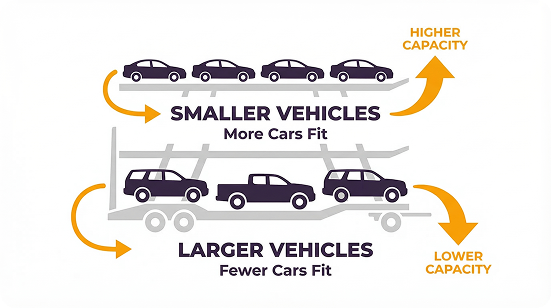
Size decides how much deck space your vehicle takes and how many other cars fit alongside it. A standard sedan is the cheapest thing to move because it slots almost anywhere on the trailer. SUVs, pickups and vans take more room and usually cost more on the same lane.


Ship or Drive: What Suits an Idaho to Arizona Move?
When a Carrier Makes Sense
Even the shortest pair, Jerome to Chino Valley at 830 miles, takes about 15.2 hours behind the wheel, and Post Falls to Willcox takes about 27.1 hours over 1,552 miles.
A carrier is worth pricing if the car has to arrive in a specific week, if two vehicles are moving together, or if you bought the car in Idaho and need it in Arizona.
Driving It Yourself
Caldwell to Cave Creek is about 18.2 hours of driving, which most people would break into two or three days with overnight stops along I-84, I-15 and US-89.
Add fuel, lodging, food and getting home again, and compare the sum with a quote that names both towns. With one vehicle and loose dates the drive can make sense; two cars, a set arrival week or an expensive flight home tip it toward a carrier.
How Long Does Idaho to Arizona Shipping Usually Take?
Most cars take 4 to 6 days from pickup in Idaho to delivery in Arizona. Jerome to Chino Valley, at 830 miles, is the short pair, and Post Falls to Willcox, at 1,552, is the long one.
That count begins at loading. Lining up a carrier ahead of that can take one to three business days; a looser pickup window widens the pool of trucks.
Weather, road work or a mechanical problem may stretch the trip, so the range is a planning figure and not a promise.
How Early Should You Book Idaho to Arizona Car Transport?
Give dispatch a few acceptable pickup dates rather than one, and book once your plans are settled. A wide window makes it likelier that a truck bound for Arizona is nearby.
The four Idaho towns sit in very different places: Caldwell is in the Treasure Valley, Jerome is in south central Idaho, Rexburg is in the east and Post Falls is in the northern panhandle. In Arizona, Chino Valley lies north of Prescott, Cave Creek is on the north edge of the Phoenix area, Coolidge sits between the Phoenix and Tucson areas and Willcox is out on I-10 in the southeast. Post Falls to Willcox measures 722 miles more than Jerome to Chino Valley.
The cross country timing guide shows how haulers break a long trip into driving days.
Open or Enclosed: Which Trailer Fits an Idaho to Arizona Move?
Open transport suits most cars moving between Idaho and Arizona. The car rides on an uncovered multi-level trailer and gets the sun and dust of the road.
Enclosed transport keeps road grit and sun off the paint along the whole route. An enclosed truck carries fewer cars, so the price is much higher than open.
Enclosed is worth it for show cars, classics and fresh paint; a daily sedan or crossover normally travels open just fine.
Enclosed Car Transport
Enclosed demand rises for high-value, specialty and seasonal vehicles, and enclosed trailers protect against road debris and weather, which matters most on longer hauls. Enclosed rigs are a small fraction of the trailers working any given lane, and that scarcity is what drives both the higher price and the longer booking lead time.
Open Car Transport
Most vehicles move on open trailers, and for most routes that is the more cost-effective way to ship a car.
Open transport works well for standard vehicles and keeps costs predictable. It also offers the widest carrier availability.
How Should You Get Ready for the Drop-Off in Arizona?
Before the truck leaves Idaho, send dispatch the complete Arizona address, including any unit number, and answer when the driver phones ahead. Where the street is narrow, suggest a retail lot or a wide street for the handover.
At delivery, inspect the car in good light and set what you see against the photos from pickup. Record new damage on the delivery report, sign only a report that is accurate, and hold on to your copy.
For Arizona registration, contact the state motor vehicle office directly.
What to Expect at the Idaho Pickup and the Arizona Handover
A car transporter is a long rig, and some streets cannot take one. In any of the four Idaho towns, a cramped street, a low branch or a one-way block may move the handover to a main road or a shopping center. For other pickup areas, see the Idaho car shipping page.
The Arizona end follows the same logic. A dirt road outside Chino Valley, a narrow lane in Cave Creek, a ranch road near Coolidge or a tight street in Willcox could stop a full rig short, and the driver may then suggest a larger lot close to your address. The Arizona car shipping page lists more drop areas.
Check paint, glass and wheels alongside the driver at loading and again at unloading, and compare them with the condition report that comes with the bill of lading. Photos with a date stamp are useful later.

Which Details Belong in Your Idaho to Arizona Quote Request?
A broker handles the booking here: Rivalane arranges the move, and a licensed carrier brings the truck and driver. Put the Idaho pickup town and the Arizona drop town in a single quote request, since moving the Idaho town can change the total miles by as much as 470, against 253 for the Arizona town.
Frequently Asked Questions