


Shipping a car from New Orleans to Jacksonville on an open trailer, expect $550 to $850 for a sedan that runs, with most deliveries 2 to 5 days after loading. Our 64 Louisiana to Florida pairs span 386 to 1,123 road miles on I-10. Book one to two weeks ahead; Florida wants its own insurance before registering the car.
Why I-10 Shapes Car Shipping From Louisiana to Florida
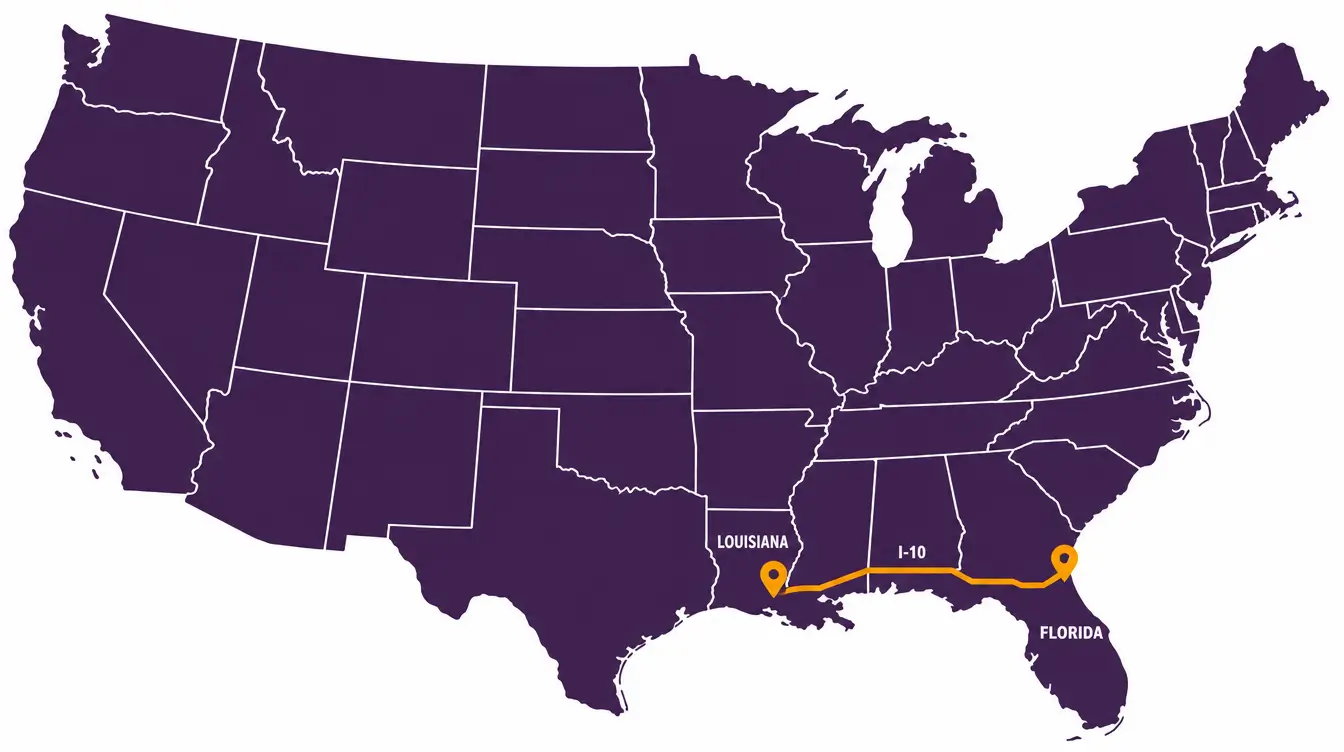
We routed louisiana to florida car shipping between eight pickup towns, New Orleans, Baton Rouge, Lafayette, Lake Charles, Houma, Alexandria, Monroe and Shreveport in Louisiana, and eight Florida cities, and the 64 pairs measure 386 to 1,123 road miles. I-10 is the thread that ties them together: every pair passes Mobile, Alabama, then Pensacola and Tallahassee. South Louisiana loads reach it early. New Orleans and Houma cars leave on I-10 past Slidell, while Baton Rouge, Lafayette, Lake Charles and Alexandria cars cross north of Lake Pontchartrain on I-12 and meet I-10 near Slidell. Shreveport and Monroe cars begin farther north, heading east on I-20 to Jackson, Mississippi, then south through Hattiesburg to pick up I-10 at Mobile. Jacksonville deliveries stay on I-10 nearly to the door, while loads for the peninsula leave it at Lake City and run south past Gainesville and Ocala.
How Much Does Car Shipping From Louisiana to Florida Cost?
Your quote depends on your vehicle, the exact pickup and delivery addresses, the season and the trailer type, so run the calculator for a figure on your dates.
On this lane the Florida address moves the miles more than the Louisiana one. From any of the eight Louisiana towns we routed, a Miami delivery runs about 477 road miles longer than a Tallahassee one. Hold the Florida city fixed instead, and the Louisiana starts differ by up to about 260 road miles, with New Orleans nearest and Shreveport farthest.
Vehicle size counts next. Pickups, minivans and full-size SUVs claim a bigger slot on the deck, so they price above a sedan, and covered space is priced above open space.
A quote far below every other one deserves a question before you book: has a carrier actually accepted it, or is it still waiting for one?
Flexible dates help most. Give dispatch a spread of pickup days and the car can ride with a truck already rolling east on I-10.

A running sedan booked on an open carrier from New Orleans to Jacksonville is currently quoted at about $550 to $850. To price your own two addresses, open the car shipping calculator.
Size moves it too: a full-size SUV, pickup or minivan is usually priced $100 to $200 higher, and enclosed space lands roughly 40 to 60 percent above the open quote.
- A peninsula delivery. From New Orleans, Orlando and Tampa sit about 90 to 110 road miles beyond Jacksonville, and Miami about 316, so the quote climbs with them.
- A north Louisiana pickup. On the way to Jacksonville, Monroe adds about 160 miles over New Orleans and Shreveport about 260.
- A loose pickup date. Several workable days give dispatch more eastbound trucks to choose from, which tends to hold the price down.
For Shreveport and Monroe loads, the line south from Jackson, Mississippi to Mobile is the same one the southern Nevada loads follow on the Nevada to Florida route.

What Factors Actually
Influence Pricing on This Route?
Five things move the price on any lane: the vehicle's size, whether it runs, how easy each end is to reach, the season and the trailer type. Booking early protects your timeline, keeps pricing steady and reduces the risk of last-minute carrier changes.


Type
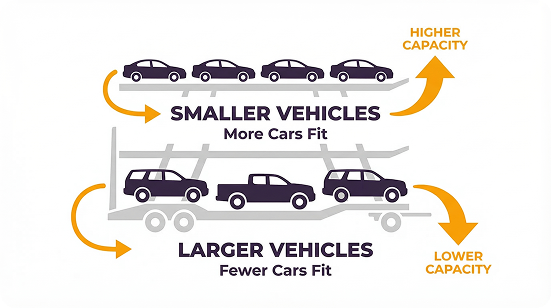
Size decides how much deck space your vehicle takes and how many other cars fit alongside it. A standard sedan is the cheapest thing to move because it slots almost anywhere on the trailer. SUVs, pickups and vans take more room and usually cost more on the same lane.


Is It Cheaper to Drive or Ship a Car From Louisiana to Florida?
Shipping Instead of Driving
Shipping makes the most sense when the Florida address is on the peninsula rather than in the Panhandle, when two cars are moving at once, or when you would rather fly down and keep the travel days for the move itself.
It spares the car 386 to 1,123 miles of interstate wear and saves you the fuel, the meals and the hotel night the longer pairs usually call for.
Driving the Route Yourself
By our routing, New Orleans to Jacksonville is about 10 hours behind the wheel, one long day or two easy ones. A Shreveport car bound for Miami needs closer to 21 hours, which usually means two or three days on the road.
On the shortest pairs, driving can cost less if you have the time and someone to bring you back. Add up the fuel, a hotel night or two, the wear and the trip home before you decide.
How Long Does Car Shipping From Louisiana to Florida Take?
Once loaded, most cars on this lane reach Florida in 2 to 5 days. New Orleans to Jacksonville, about 547 miles, usually lands near the short end, and the longest pair we routed, Shreveport to Miami at about 1,123 miles, can use the whole range.
The wait before loading is a separate step. Matching the order with a carrier is the first job, and Rivalane usually finishes it in one to three working days; several workable pickup days make that faster.
A loaded carrier commonly covers 400 to 500 miles a day, so even the longest pairs here come to two or three days of driving, with stops for other cars on the same trailer added on top.
When Should You Book Car Shipping From Louisiana to Florida?
One to two weeks before your pickup date usually gives dispatch enough room on a lane of this length. Interest in this route peaked in October and November in the keyword data we read, so add a few days of notice from October on.
Weather can matter anywhere along the route, not only at the two ends. Every pair we routed runs I-10 past Mobile and Pensacola, so a tropical storm on that stretch can stall trucks for a day or longer even when New Orleans and Jacksonville are dry. The National Hurricane Center dates the Atlantic season from June 1 to November 30, with most activity between mid-August and mid-October, so keep the delivery date loose in those weeks.
Should a Louisiana Car Ride Open or Enclosed to Florida?
Open car transport is how most cars on this lane travel, loaded on a two-level trailer with other vehicles, the least expensive option on this lane.
Enclosed car transport shields the car inside solid walls and a roof, so rain, road spray and grit stay off the paint, and it usually costs 40 to 60 percent more.
That premium makes sense for a classic, a car with fresh paint, a low sports car or anything you would hate to see chipped.
Enclosed Car Transport
Enclosed demand rises for high-value, specialty and seasonal vehicles, and enclosed trailers protect against road debris and weather, which matters most on longer hauls. Enclosed rigs are a small fraction of the trailers working any given lane, and that scarcity is what drives both the higher price and the longer booking lead time.
Open Car Transport
Most vehicles move on open trailers, and for most routes that is the more cost-effective way to ship a car.
Open transport works well for standard vehicles and keeps costs predictable. It also offers the widest carrier availability.
Does Your Louisiana Car Need Florida Plates Yet?
Florida asks for a Florida title, plate and policy once your situation calls for them, not on the day the truck arrives. Find the line that fits your move.
- You have moved to Florida. The state treats you as a resident from the earliest of five events: a Florida voter registration, a homestead exemption claim, a child starting at a Florida public school, a new Florida job, trade or profession, or living in Florida for over six consecutive months. That starts a 10 day window for Florida insurance plus the title and registration, and a 30 day window to get a Florida driver license, which means a visit in person.
- You still live in Louisiana but work in Florida or have a child in a Florida public school. The car still needs a Florida registration, a Florida plate and a Florida policy.
- The car is paid off. Take ID for each owner, Florida proof of insurance, the original Louisiana title and form HSMV 82040 carrying the signature of each owner. Next, someone authorized must look at the VIN in person and write it on HSMV 82040 or on HSMV 82042, which can be a county tax collector employee, a police or military police officer, a Motorist Services compliance examiner or a licensed Florida dealer. For the service center visit, see our Florida registration walkthrough, and for the VIN step, the Florida VIN verification guide.
- The car has a loan. Contact the lender that holds the Louisiana title and request a transfer to Florida. Registration is required whether or not it agrees; a lender that says no can put that answer in a letter on its letterhead, and a motor vehicle service center will register the car with it.
- In every case, the policy. The Florida policy must be bought from a company with a Florida insurance license, with at least $10,000 each of Personal Injury Protection and of Property Damage Liability, and it must stay active for the whole registration period, even while the car sits unused or is out of the state. Your current agent may be able to move your policy to a Florida one.
- Back in Louisiana, the plate. The Louisiana OMV wants the plate canceled first and the liability policy second. Cancel through its online service, turn the plate in at any OMV location or send it by mail; with the online route the plate stays with you, but it has to be taken off the car and destroyed. The same step applies on the Louisiana to New York route.
Source: the FLHSMV Insurance Requirements page and the FLHSMV New Resident page, with the plate step from the Louisiana OMV.
What Happens at Pickup in Louisiana and Delivery in Florida?
Settle both handoff spots with dispatch before a truck is assigned. The rig is long and heavy, and it has to park, drop its ramps and turn around, so a broad street or an empty lot works best.
In Louisiana, tight blocks in older New Orleans neighborhoods, low tree limbs and rural parish roads with soft shoulders often move a pickup to a nearby store or church lot. In Florida, cul-de-sacs and narrow subdivision streets around Jacksonville, and condo garages farther south, often shift delivery to a nearby parking area. More on each end sits in our guides to car shipping in Louisiana and car shipping in Florida.
Do the walk-around with the driver at both ends, and check that each chip, scratch and dent goes onto the bill of lading before you sign. Before pickup, take dated photos of every side and clear out personal items.

Key Things to Know Before Shipping a Car From Louisiana to Florida
Rivalane coordinates Louisiana to Florida bookings out of Melville, New York. Expect a licensed carrier to be confirmed in one to three working days. From pickup to the Florida address, real-time tracking shows where the car is. Once the car has Florida plates, cancel the Louisiana plate before you drop the Louisiana policy, as the Louisiana OMV requires.
Frequently Asked Questions