




A drivable sedan moved by open trailer from Nebraska to Florida typically costs $725 to $1,175, and delivery usually takes about 3 to 6 days from loading. We routed 16 pairs spanning 1,316 to 1,652 miles, and the Florida end shifts the distance much more than the Nebraska end, so give the Florida city first when requesting a quote.
How Do Cars Reach Florida From La Vista, Blair, Columbus and York?
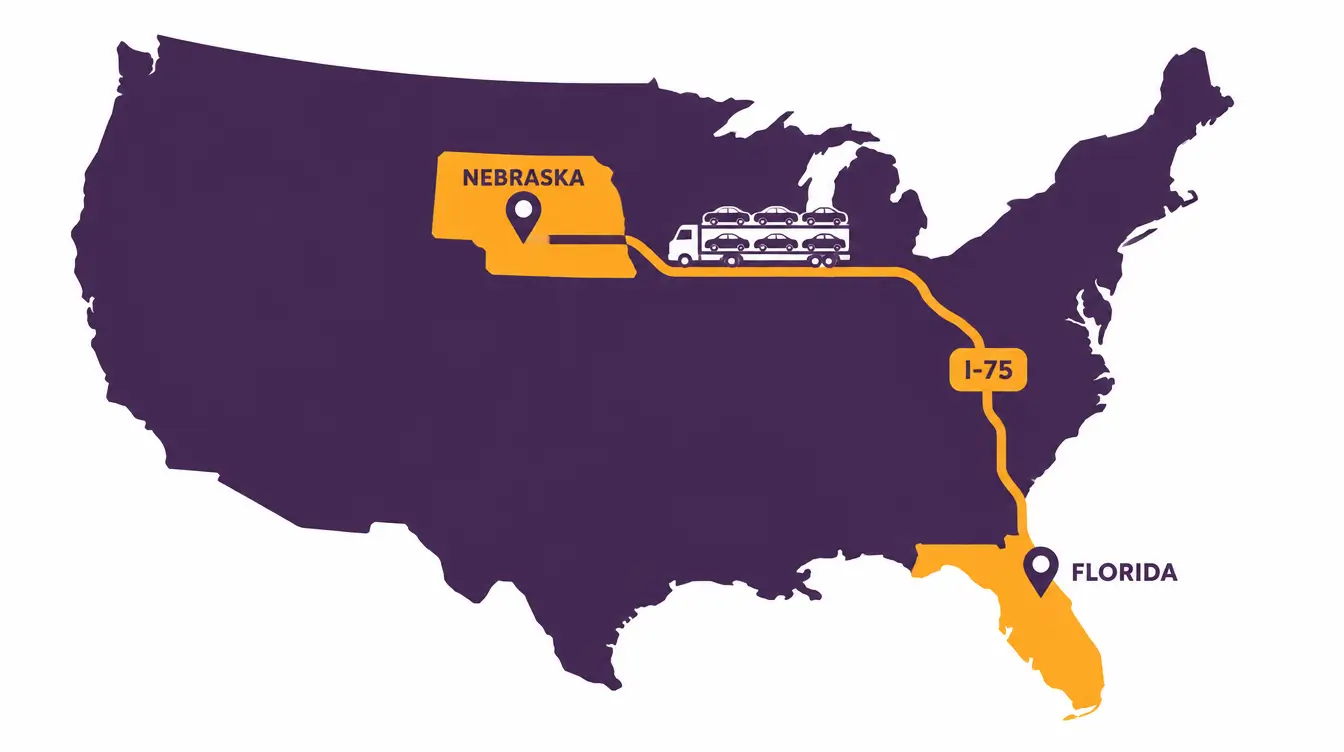
Our Nebraska to Florida car shipping routing covers 16 pairs, with four Nebraska starts (La Vista, Blair, Columbus and York) set against four Florida cities (Gainesville, Lakeland, Port St. Lucie and Cape Coral). The shortest, La Vista to Gainesville, measures 1,316 road miles and the longest, Columbus to Cape Coral, 1,652, so seven pairs fall under 1,500 miles and nine run past it. The Florida end does most of the work: from any one start the four cities spread across up to 249 miles, while for any one Florida city the four starts differ by no more than 88. By our routing, a load leaves eastern Nebraska for I-29 and follows it south to Kansas City, then I-70 carries it east to St. Louis. A short run on I-64 and I-57 leads to I-24, which heads southeast to Chattanooga, and I-75 does the rest of the work into Florida. Gainesville and Lakeland cars stay on I-75 almost to the end, Cape Coral cars ride it down the Gulf side, and Port St. Lucie cars leave it for a separate road toward the Atlantic side. The driver makes the final choice of roads.
Which Matters More for the Price, the Nebraska Town or the Florida City?
Your quote depends on your vehicle, the exact pickup and delivery addresses, the season and the trailer type, so run the calculator for a figure on your dates.
Between these two states the Florida end drives the mileage. From La Vista, Gainesville is 1,316 road miles away, Lakeland 1,433, Port St. Lucie 1,537 and Cape Coral 1,565, and the other three Nebraska starts list those cities in the same sequence.
The Nebraska town barely changes the total. On the way to Lakeland, La Vista is 1,433 miles, Blair 1,463, York 1,498 and Columbus 1,521, only 88 miles from the nearest start to the farthest.
A lifted truck or three-row SUV uses extra length on the trailer, and enclosed service, which holds fewer cars than an open rig, is priced higher.
Tell dispatch your Nebraska town and Florida city and offer a pickup window with a little give; the price is then worked out from those two addresses.
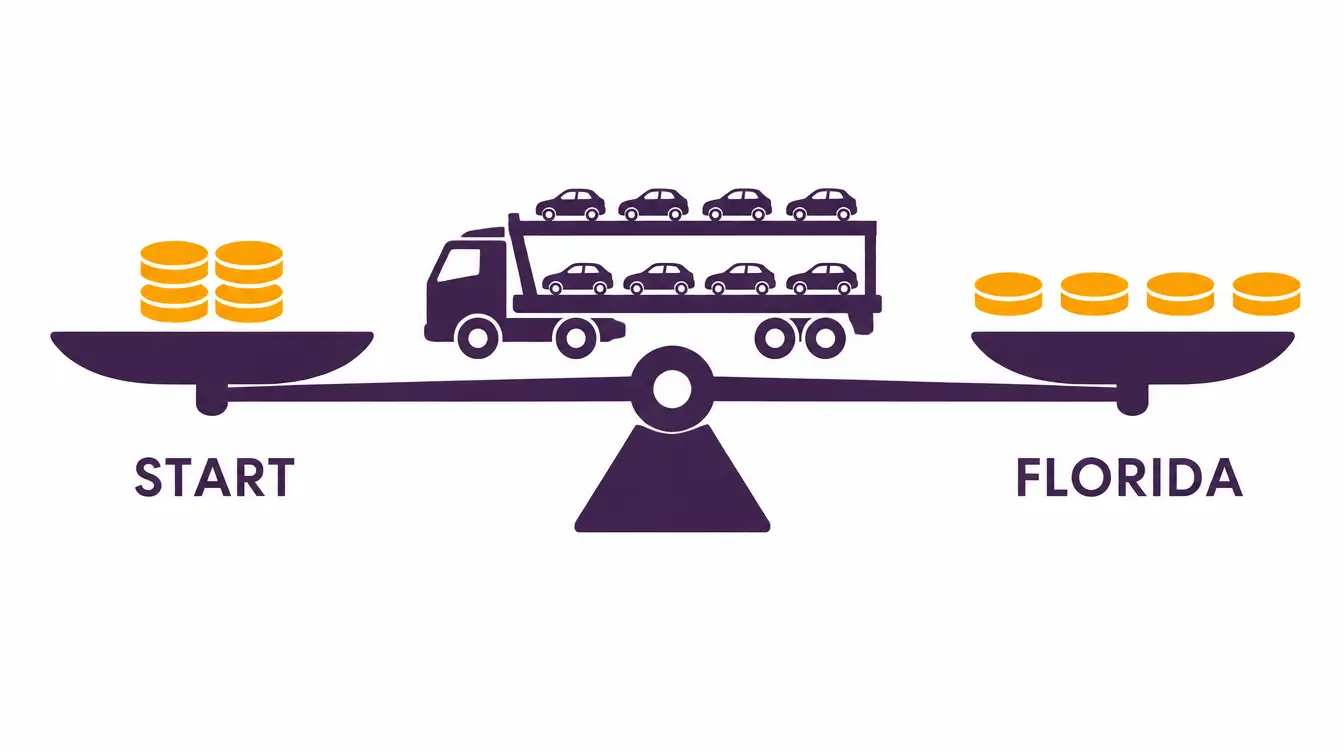
Expect an open trailer to run $725 to $1,175 to move a drivable sedan between Nebraska and Florida. La Vista to Gainesville, our shortest pair, sits low in that band, and Columbus to Cape Coral sits high. Enter your Nebraska town and Florida city in the calculator to see a figure shaped by both.
Vehicles like a pickup, van or full-size SUV add about $100 to $200, since they occupy extra trailer room. A car that cannot run under its own power needs a carrier fitted with a winch, and dispatch quotes that extra handling separately. Expect enclosed service to land roughly half again above open pricing, since an enclosed load holds fewer cars.
- The Florida city. Gainesville is nearest, then Lakeland, Port St. Lucie and Cape Coral, spread across as much as 249 miles from any one start.
- The Nebraska town. La Vista is nearest and Columbus farthest, a gap of at most 88 miles to any one Florida city.
- The road. I-29 carries loads out of Nebraska, I-70 and I-24 cover the middle of the trip, and I-75 takes cars the rest of the way into Florida.
Be wary of a bid that undercuts all the rest. If no carrier will accept it, the car can sit unassigned for days.

What Factors Actually
Influence Pricing on This Route?
Five things move the price on any lane: the vehicle's size, whether it runs, how easy each end is to reach, the season and the trailer type. Booking early protects your timeline, keeps pricing steady and reduces the risk of last-minute carrier changes.


Type
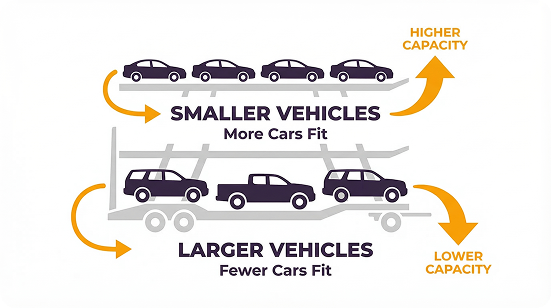
Size decides how much deck space your vehicle takes and how many other cars fit alongside it. A standard sedan is the cheapest thing to move because it slots almost anywhere on the trailer. SUVs, pickups and vans take more room and usually cost more on the same lane.


Is It Smarter to Drive From Nebraska to Florida or Ship the Car?
Letting a Carrier Do the Driving
The shortest pair, La Vista to Gainesville, is 24.4 hours behind the wheel, and Columbus to Cape Coral is 30.6. Even at ten driving hours a day, that means three or four days of driving plus two or three motel stays.
Shipping suits a move with a tight schedule on the Florida end, or a household relocating two cars at once.
Making the Drive Yourself
La Vista to Lakeland is about 1,433 miles and 26.7 hours, which comes to roughly three days on the road at ten driving hours daily.
Count fuel, meals, motel nights and the way home from Florida, then compare that total with a price built on your actual addresses. With one car and time to spare, driving can make sense, and shipping makes more sense when two cars are moving or the calendar is tight.
What Is the Typical Transit Time From Nebraska to Florida by Car Hauler?
Typically, from loading to delivery, expect about 3 to 6 days. Pairs under 1,500 miles, such as La Vista to Gainesville at 1,316, usually land toward the early end, and the 1,652-mile Columbus to Cape Coral run usually lands toward the late end.
Allow 1 to 3 working days before loading for dispatch to assign a carrier; that wait does not count toward transit.
Read the arrival window as an estimate. A late pickup, a storm along I-70 or I-24, or a driver who makes other stops beforehand can each add a day or two.
What Is the Right Booking Window for Nebraska to Florida Auto Transport?
Book once your dates are fixed, and say how far your pickup can move either way. A hauler already running I-29 or I-70 is easier to find than one sent out to collect a single car, so a flexible window widens your options.
Columbus to Cape Coral is the longest of the 16 pairings, so lock in that booking early. Port St. Lucie sits off I-75 on the Atlantic side, and a delivery there can mean a detour for the carrier.
Our cross-country timing guide breaks down what adds days to a haul, while the South Dakota to Florida route follows the same I-29 corridor from a start further north.
Open or Enclosed: Which Trailer Suits Your Nebraska to Florida Car?
Open transport is how most cars travel this lane, riding an uncovered deck that shares I-29, I-70 and I-75 with the rest of the freight.
Enclosed transport shuts the car away from rain, hail and flying road debris all the way to Florida. Each enclosed load holds fewer cars, so the price lands roughly half again above open transport.
Collectors, owners of freshly painted cars and drivers of low sports models are who usually choose enclosed. An everyday sedan generally does fine on an open trailer.
Enclosed Car Transport
Enclosed demand rises for high-value, specialty and seasonal vehicles, and enclosed trailers protect against road debris and weather, which matters most on longer hauls. Enclosed rigs are a small fraction of the trailers working any given lane, and that scarcity is what drives both the higher price and the longer booking lead time.
Open Car Transport
Most vehicles move on open trailers, and for most routes that is the more cost-effective way to ship a car.
Open transport works well for standard vehicles and keeps costs predictable. It also offers the widest carrier availability.
What Should Be Ready When Your Car Arrives in Florida?
Give dispatch the full delivery address in Florida and a phone number that will be answered on the day. If the entrance is cramped, suggest a large lot or a wide road nearby.
When the truck unloads, check the car in good light against your pickup photos, looking over panels, roof and tires. Have the driver write down any new damage on the paperwork before you sign, and hold on to your copy.
Registration, insurance and inspection in Florida go through state agencies, which this page leaves out. The Florida agency for motor vehicle records can tell you what applies.
What Will Pickup in Nebraska and Delivery in Florida Look Like?
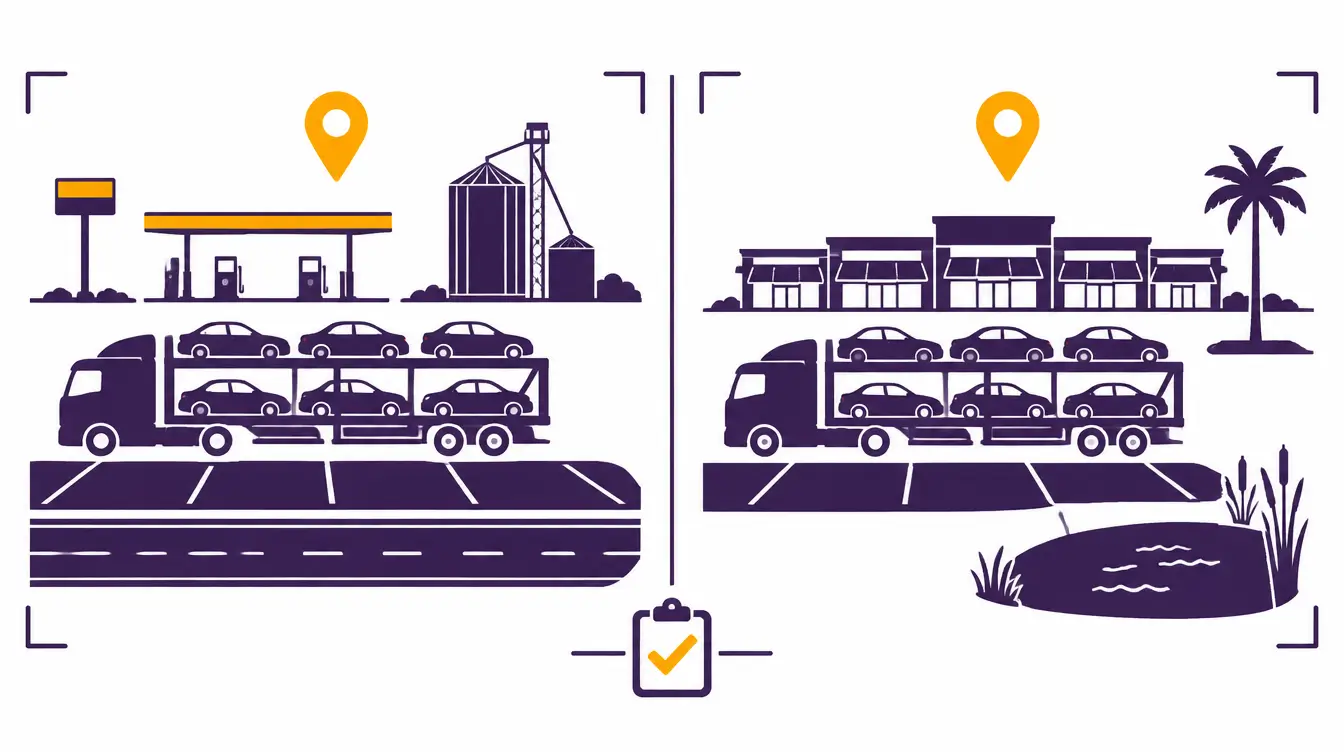
Car haulers are long rigs, so the driver looks for a curb or lot with space to unload. In La Vista, subdivision streets and townhome courts can be too tight, and the pickup may shift to a store lot nearby. In Blair, Columbus and York, a wide main street or a lot near the highway usually works best. For pickups across the rest of Nebraska, see our Nebraska car shipping page.
At the Florida end, gated communities in Lakeland and Cape Coral can turn away a full-length trailer, and the handoff may move to a plaza lot close by. Gainesville and Port St. Lucie drivers may meet at the edge of a shopping center. For delivery across Florida, see our Florida car shipping page.
At pickup, walk the vehicle with the driver and get each existing mark listed on the bill of lading. Repeat the walk at delivery and take dated photos both times.
What Is Worth Settling Before You Book Nebraska to Florida Transport?
Rivalane, a broker located in Melville, New York, places each Nebraska to Florida order with a licensed hauler. Start any quote request with the Florida city, because the 249 miles between Florida cities outweigh the 88 between Nebraska starts.
Frequently Asked Questions