Can You Buy a Car From a Dealer in Another State?
Yes. A dealer in one state can sell to a buyer who lives in any other state. The sale itself is the easy part. The decisions that cost money come from details that are easy to miss before signing: which state taxes the sale, which state issues the title and plates, whether the car needs a temporary tag to leave the lot and how it gets home.
This guide follows the order a buyer meets those questions, from the first call with the dealer to the day the car is released for pickup.
What Should You Confirm With the Dealer Before You Sign?
Start with what the law already gives you. Under the federal Used Car Rule, a dealer has to display a Buyers Guide in every used car it offers, and the guide says whether the car comes with a warranty or is sold as is. Maine and Wisconsin use their own versions of the form. The Federal Trade Commission guidance on buying from a dealer also notes that federal law does not give you three days to cancel and return a car, so a verbal promise from a salesperson is not a safeguard. Get every promise in writing.
Then ask the dealer these questions before you send a deposit:
- Where will delivery take place, and which state's sales tax will you collect on this sale?
- Will you submit title and registration paperwork for my home state, or give me the documents to file myself?
- Is there a lien on the car, and who holds the title?
- Do you issue a temporary plate for out-of-state buyers, and for how long?
- Who is the contact person for pickup, and what are your release hours?
Buyers can also get a vehicle history report through an approved NMVTIS provider. The U.S. Department of Justice maintains the provider list, and the report shows title data and brands such as salvage. Pair it with an independent inspection near the dealership, because you cannot see the car yourself.
Who Collects Sales Tax When You Buy From an Out-of-State Dealer?
Two different taxes can be in play, and they come from two different states. The first is what the selling dealer collects at the sale, which depends on its own state's rules and on where you take delivery. The second is what your home state may collect when you register the car. Treat them as separate questions and ask the dealer to show any tax it collects as its own line on the bill of sale.
Florida shows why the first question needs a direct answer. A Florida dealer can apply a partial exemption on Form DR-123 when the buyer declares an intent to license the vehicle in the buyer's home state within 45 days of purchase. According to the Florida Department of Revenue guidance, the form is completed at the time of sale and handed to the dealer. That publication is TIP 26A01-01, current as of February 11, 2026. Whether a Florida dealer that delivers the car outside Florida collects Florida tax at all is a different question with its own rules, so do not assume the DR-123 answers it. Ask which rule the dealer is applying, and see our guide to Florida dealer sales tax and out-of-state buyers.
The second tax is where home states differ, and four examples show how credits can change the bill:
- California. Use tax applies when you buy a vehicle for use in California without paying California sales tax, and the rate follows the address where you register the car, according to the California Department of Tax and Fee Administration. You may be able to claim a credit for tax paid to the other state, so keep the receipt that shows it. Our guide to California rules for a car bought in another state covers the emissions rules that apply before you buy.
- Texas. A Texas resident who brings home a vehicle bought in another state owes Texas motor vehicle use tax, less credit for sales or use tax paid to other states, according to the Texas Comptroller. Our guide to Texas use tax on a car bought elsewhere explains how the amount is worked out.
- New York. New York collects its own tax at registration unless it was already paid. A buyer claims credit for tax paid elsewhere on Form DTF-804 and shows a bill of sale with the purchase price and the tax paid, according to the New York DMV sales tax page. New York allows the credit only where its rules permit, so confirm it applies to the state you bought in. For the reverse case, see how New York treats dealer sales to nonresidents.
- Florida. Florida generally charges use tax on a vehicle bought in another state and titled in Florida, plus any local discretionary sales surtax, and it credits a like tax paid to another state, according to the Florida Department of Revenue guidance. Take a Florida buyer who purchases a used car from an Oregon dealer. Oregon does not have a general sales tax, according to the Oregon Department of Revenue, and its vehicle privilege tax exempts sales to buyers who are not Oregon residents, according to the Oregon vehicle privilege and use tax page. The dealer may therefore show no tax on the bill of sale, and no tax paid means no credit, so the buyer should expect to settle the Florida use tax when titling the car and should keep the bill of sale as proof of what was paid and when. Our Florida registration guide for out of state cars covers the title and registration visit.
The same purchase can leave a different balance in each state, and a credit is only as good as the proof behind it.
What Title and Registration Documents Should You Get?
Ask for a complete set of documents at signing, not after the car has left. A home-state office will want most of these:
- A bill of sale showing the price, the date, the VIN and any tax collected.
- The title, or the lienholder details and the way the title will reach you if a lender holds it.
- An odometer disclosure signed by the dealer.
- A copy of the Buyers Guide for a used car, or the manufacturer's certificate of origin for a new one.
- Any temporary plate or permit paperwork the dealer issued.
Your home state decides what else it needs. Our registration guides cover the steps for registering a dealer-bought car in Florida, what a Texas county office needs for a car bought elsewhere, California smog check and registration for a car bought elsewhere and New York registration steps for a car bought in another state. Ask the dealer in writing how and when the title will be sent, and keep copies of everything you sign.
Do You Need a Temporary Tag to Drive the Car Home?
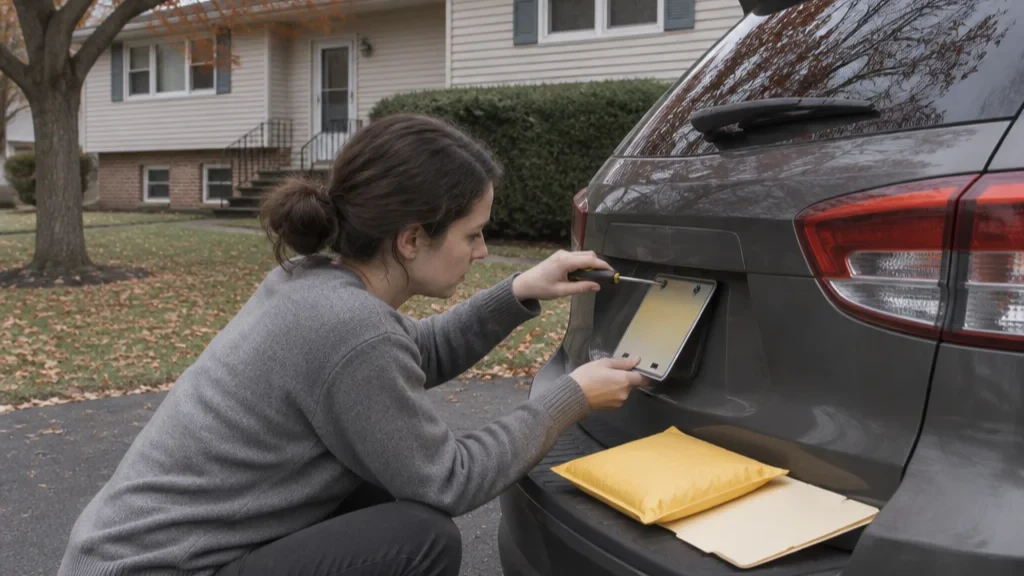
If you plan to drive the car home, yes, you need a plate or permit that is legal on the roads you will use. Before you leave the lot, confirm four things: who issues it, how long it lasts, where it must be displayed and whether your insurance is already active on the car. Then check with your home state agency that the plate fits its rules.
Texas gives one current example. Under House Bill 718, effective July 1, 2025, Texas dealers issue a plate to non-Texas buyers. The TxDMV rules for out-of-state buyer plates say it is valid for 60 days and must be displayed on the rear of the vehicle, not in the window. If you buy from a Texas dealer, ask for that plate by name.
New York works differently. For a car bought in New York and taken to another state, the New York DMV in-transit permit page describes an interstate in-transit permit. The dealer plate manual says an out-of-state permit is valid for 30 days or until the vehicle is registered outside New York, whichever comes first. For a New York resident who buys in another state, the DMV says to get the temporary plate and registration through that state's DMV office.
If a carrier will move the car instead of you, ask the dealer what it requires on the car at pickup and whether it still issues a temporary plate at the sale. Do not assume either way.
What Does the Dealer Need to Release the Car to a Carrier?
Dealers set their own release rules, so confirm them before pickup day. Our Help Center explains what a dealer pickup requires, including pickups from dealerships and auction yards. Ask the dealer for its release requirements, its pickup hours and the name of the person who will hand over the car.
Have the bill of sale and proof of payment ready, because a dealer may hold the car until it can see that the sale is complete. At pickup, the carrier's driver also completes a bill of lading, and our guide to what the bill of lading records shows what to check on it.

Should You Ship the Car or Drive It Home?
Driving gets the car home at the cost of your time, fuel and miles on a car you just bought. Shipping moves it on a carrier instead. Rivalane is a licensed property broker (USDOT 4178374), not a carrier. We arrange transport with licensed, insured carriers and do not operate trucks ourselves, and we can arrange a pickup from a dealership. For the Florida buyer in the Oregon dealer example above, our page on moving a car from Oregon to Florida covers the lane to Florida.
If you want to see how the process runs, read the full auto shipping process, what happens once a shipment is booked and shipping a car after an out-of-state purchase. When you are ready, price your dealer pickup with the car shipping calculator or request a quote.
Out-of-State Dealer Purchase Checklist
- Get the Buyers Guide, the price and every promise in writing.
- Run the VIN through an approved NMVTIS provider and book an independent inspection.
- Ask which state's tax the dealer collects and have it shown on the bill of sale.
- Check your home state's rules for use tax and for credit on tax paid elsewhere.
- Collect the bill of sale, title or lien details, odometer disclosure and any plate paperwork.
- Confirm the temporary plate: issuer, length of validity, display rules and insurance.
- Confirm the dealer's release requirements, pickup hours and contact person.
- Have the bill of sale and proof of payment ready for pickup.
- Keep copies of every document and the tax receipt.
Frequently Asked Questions
Can you buy a car from a dealer in another state?
Do dealerships ship cars to other states?
Do you pay sales tax in both states when you buy a car out of state?
Do you need a temporary tag to drive a car home from an out-of-state dealer?
Is there a three-day right to cancel a car purchase from a dealer?
How do you check a car history before buying from a distant dealer?