Rivalane arranges car shipping to and from Oregon with licensed, insured carriers running the I-5 corridor and the routes beyond it. Tell us the pickup and delivery addresses and we match your vehicle to a carrier already covering that lane, then set out what Oregon asks for once the car arrives.





5-Star Average Rating
Licensed and Insured
Door to Door Service
Nationwide Coverage
Vetted Carriers
Rivalane is a broker rather than a trucking company, and the distinction matters more than it sounds because it tells you who is responsible for what. We hold the relationship with you, check a carrier's operating authority and cargo insurance before your vehicle is assigned to them, and stay the point of contact from booking through delivery. The carrier owns the truck, the driver and the coverage that applies to your car in transit. Anyone who blurs those two roles is making a claim about their own liability that will not hold up if something goes wrong.

Cost and timing depend on your route, trailer type, vehicle size, and the time of year. The ranges below reflect typical market pricing and transit windows by distance, not a commitment on either. Your actual quote is based on real carrier availability on your specific route at the time of booking.
Oregon's pricing comes from a single spine rather than from the size of the state. I-5 runs the full length from the California line to the Columbia River, carrying West Coast freight through Medford, Roseburg, Eugene, Salem and Portland, so a vehicle moving to or from any of those sits on a lane carriers already run. I-84 branches east through the Columbia River Gorge toward Pendleton and Ontario, and I-205 loops the Portland metro. Away from those lines the picture changes quickly. The coast on US-101, central Oregon around Bend and Redmond on US-97, and the high desert counties east of the Cascades are reached by detour rather than by through traffic, and that detour is most of what a quote to those addresses is pricing.
Two Oregon specifics sit inside a carrier's cost without ever appearing on your quote. The first is elevation. Siskiyou Summit, where I-5 crosses toward California south of Ashland, is the highest point on the entire interstate at 4,310 feet, and it is the stretch most likely to close or move to chain restrictions in winter. The Cascade passes carrying US-26 over Mount Hood, US-20 and OR-22 over Santiam, and OR-58 over Willamette draw ODOT traction and chain requirements in the same months, so a run that looks short on a map can cost a carrier an extra day when a pass turns. The second works the other way. Oregon charges no tolls on its interstates, so the route you are quoted is almost always the route your vehicle takes, with no toll schedule pushing a carrier onto a longer road to save money. Season still moves the number, and pickup windows widen in the mountains and along the coast between November and April.
Vehicle size, whether the car runs, and trailer type all move the number, and enclosed transport runs roughly 40 to 50 percent above open because there is less of it on the road. The factor most within your control is lead time. Booking a week or two ahead puts your vehicle on a truck already running the I-5 corridor rather than one routed out to collect it, and that gap widens for addresses off the corridor, where carriers pass less often and a flexible pickup window is worth more than an exact date.
Get your Oregon quoteFive stages, from the first quote through to the inspection at your door. Most of the work happens before the truck arrives.





Share where the vehicle starts and where it needs to be delivered. We check the route and the distance and send a quote built on that lane rather than a generic per-mile estimate.

Pick a pickup window that suits your schedule. We assign a carrier already heading in that direction, which is usually quicker to arrange than routing a truck out to collect a single vehicle.

Take out personal belongings and have the keys ready to hand over. When the driver arrives, they walk around the vehicle and record its condition on the inspection report, which is the document you compare against at delivery.

The driver loads the vehicle and secures it for the route, on an open or enclosed trailer depending on what you booked. You get short updates while it travels, so you know roughly where it is and when to expect it.

At drop-off the driver goes through the inspection notes with you and confirms the vehicle matches the condition recorded at pickup. Once you have both agreed, the shipment is complete.

Every Oregon shipment runs on the same carrier network, but the right setup depends on the vehicle, the route, and how far your address sits from the I-5 corridor. These are the options worth knowing before you book.
Most Oregon shipments start or finish somewhere on I-5, between Portland and its suburbs, Salem, Eugene, Roseburg and Medford, or run east on I-84 through the Columbia River Gorge. Those lanes carry regular carrier traffic, which makes them the easiest to schedule. The same network handles the long-distance runs to California, Texas, Florida and the East Coast.
Open carriers suit most everyday vehicles, including sedans, SUVs and light trucks. Your car travels secured on an open trailer under the carrier's cargo insurance. This is the option with the most trucks running Oregon routes, so it is usually the easiest to book at short notice.
Enclosed transport adds protection for luxury, classic and specialty vehicles, with the car travelling inside a covered trailer away from weather and road debris. There is less enclosed capacity running Oregon routes than open, so it is worth booking further ahead.
Expedited shipping prioritises your vehicle with the next suitable carrier rather than waiting for the best-matched one, which shortens the wait before pickup. It costs more, and it earns its place when a date is fixed by something outside your control, like a property closing or a start date.
Plenty of Oregon addresses sit well away from the interstates: the coast along US-101, central Oregon around Bend and Redmond, and the counties east of the Cascades. Carriers reach those less often, so we plan them as their own leg rather than an afterthought, and we say up front when a meeting point makes more sense than the driveway.
Every shipper claims to be reliable. Here is what actually separates a well-run move from a risky one, and what to ask before you book anyone for an Oregon route.
Ask whether the company can name a real Oregon constraint before you raise it, such as how they reach an address on the coast or east of the Cascades, where the nearest workable meeting point may not be the driveway.
Ask whether the price you are quoted is based on your actual route and vehicle, or a generic distance estimate that gets revised once a carrier is assigned.
Ask what happens if no carrier is available on your exact date, which matters most between November and April, when ODOT chain restrictions on Siskiyou Summit and the Cascade passes can hold trucks up. A shipper working from an existing carrier network can usually offer options faster than one starting from scratch.
Get your Oregon quoteDemand into and out of Oregon comes from a few clear directions. Here is who ships most often.
.svg)
Most of the demand we see into Oregon comes from buyers who purchased a vehicle sight unseen from somewhere else in the country. We arrange pickup from the seller or the dealership and deliver it to your Oregon address, so nobody has to fly out and drive it back. Two things are worth checking before you buy, and both turn on the same number. A vehicle bought from a dealer outside Oregon with 7,500 miles or fewer on it falls under the state's 0.5 percent vehicle use tax, which the Department of Revenue calculates on a price that expressly includes the transport charge. Separately, a passenger vehicle of model year 2009 or newer with 7,500 miles or fewer has to show Low Emission Vehicle compliance before DMV will title it, though electric and hybrid vehicles are exempt.
Estimate your shipment →.svg)
A vehicle you already own is treated differently from one bought on the way in. Oregon's vehicle use tax reaches purchases from out-of-state dealers, not a car that has been yours for years, so an ordinary household move does not trigger it. Scheduling is the part that needs planning instead. Most arrivals we handle are headed for Portland and its suburbs, while Bend and central Oregon sit off the I-5 corridor and are worth booking earlier.
Vehicle transport services →
A vehicle that does not start needs a carrier with a winch and the right loading setup, and that is a smaller pool than standard open transport. Tell us the condition up front, including whether it rolls, steers and brakes, and we match it to a carrier equipped for it rather than discovering the problem at pickup. The same applies to a project car coming home from a workshop or a long-stored vehicle leaving a garage.
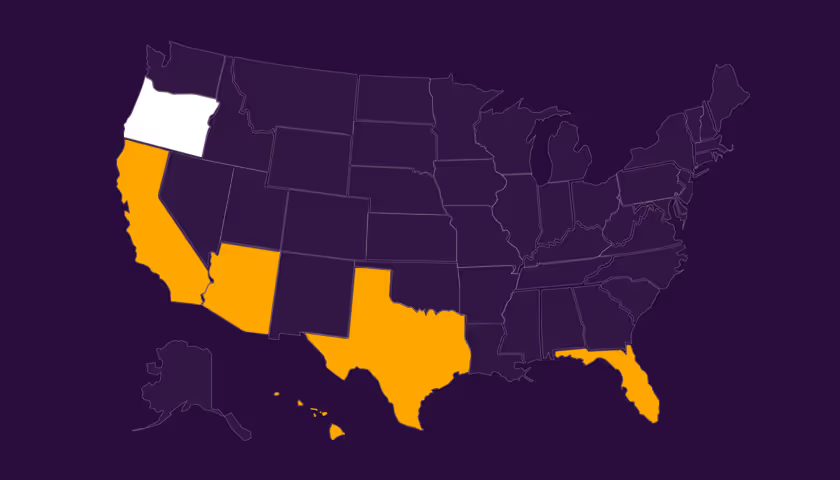
Quote a non-running vehicle →Looking to ship your car to another state or across the country? Rivalane arranges transport between Oregon and all 50 states. Pick a state to see how that route works.
Oregon divides into 36 counties, and the population is not spread evenly across them. Most of it sits in the Willamette Valley between Portland and Eugene, with Medford anchoring the south and Bend holding the centre.
Portland is the one metro that changes how a shipment is planned. It spreads across Multnomah, Clackamas and Washington counties, taking in Gresham, Hillsboro, Beaverton, Tigard, Tualatin, Lake Oswego and Oregon City, and it is where I-5, I-205 and the start of I-84 all meet. Two things follow from that. The access problem here is the reverse of the one out on the coast or east of the Cascades: in the older, denser streets a full size transporter often cannot turn in at all, so a nearby meeting point is the practical answer rather than a compromise. And because the Columbia River is the state line, an address described as Portland sometimes sits across it in Vancouver, Washington, which is a different state for titling, registration and tax. Worth confirming which side of the river you are on before you book.
South of the metro, the Willamette Valley runs down the same I-5 spine through Salem, Albany, Corvallis and Eugene. Medford and Ashland sit at the southern end near the California line, Bend and Redmond hold the centre of the state on US-97, and the coast strings out along US-101 from Astoria down through Newport and Coos Bay to Brookings. The list below shows the cities we pick up from and deliver to, with the ZIP codes each one covers.