Minnesota car shipping runs on two roads. I-94 crosses the state east to west, I-35 runs north to south, and they meet in the Twin Cities, where most of the carriers working Minnesota pass through on their way somewhere else. Rivalane matches your vehicle to a carrier already covering your lane, whether that is a run down to Chicago, a haul east to New York, or a pickup out past Duluth where trucks come by less often. You get a licensed, insured carrier, a realistic pickup window, and one point of contact from booking through to delivery.





5-Star Average Rating
Fully Insured
Open and Enclosed Transport
Nationwide Coverage
Licensed, Vetted Carriers
Minnesota car shipping turns on direction more than distance. Which way you are heading decides how quickly a carrier appears, because the Twin Cities sits at a crossing rather than inside a cluster. Runs east on I-94 or south on I-35 join lanes that are already busy. Runs north toward Duluth, west into the Dakotas, or out to the smaller counties compete for far fewer trucks. We quote and schedule against that reality rather than against a mileage table, so you hear a realistic window at the start instead of a revised one later.


Cost and timing depend on your route, trailer type, vehicle size, and the time of year. The ranges below reflect typical market pricing and transit windows by distance, not a commitment on either. Your actual quote is based on real carrier availability on your specific route at the time of booking.
Minnesota prices off one dense anchor rather than a spread of them. The Twin Cities holds roughly 3.7 million people at the crossing of I-94 running east to west and I-35 running north to south, and most carriers working the state pass through that junction on their way somewhere else. What sits beyond it is thin. Rochester is about 90 miles out and Duluth about 155, and after that the next substantial market is Chicago at roughly 410 miles, with Milwaukee, Des Moines and Fargo the only other options inside 400. A pickup in the metro therefore rides a lane somebody already runs, while an address in the southwest counties or up the North Shore is priced against a truck that has to come and collect it.
Winter here is a scheduling fact rather than a seasonal inconvenience, and MnDOT publishes the figures that show why. Every state highway carries a snow and ice clearing target set by traffic volume, running from 0 to 3 hours on the busiest roads out to 9 to 36 hours on the least travelled ones. The interstate through the metro is back to bare lane long before a low-volume highway in the far north or the southwest is, so a December or January pickup off the corridors is worth booking with more room in the window. The same gradient returns in spring, when MnDOT sets seasonal load restrictions by frost zone that can hold for up to eight weeks and route carriers away from secondary roads.
Vehicle size, whether the car runs, and trailer type all move the number, and enclosed transport runs roughly half again above open because far less of it is on the road. The factor most within your control is lead time. Booking a week or two ahead puts your vehicle on a truck already running I-94 or I-35 rather than one routed out to fetch it, and that gap widens the further your address sits from either road. It matters more again on long lanes, because Minnesota's cross-country runs fill on national freight schedules rather than on yours.
Get your Minnesota quoteFive steps, and the first two decide most of what follows. Once your route and your date window are set, the sequence below runs the same way whether the vehicle is leaving the Twin Cities or arriving in a small town three hours out.





Give us the exact pickup and delivery addresses rather than two city names, because in Minnesota the distance from the nearest interstate moves the number more than the mileage does. We break down the route and the cost factors and give you an upfront quote before anything is booked.

Pick the window that suits your schedule. A wider window gives us more carriers to work with, and that matters most outside the metro. Once a carrier accepts the assignment we confirm the plan and tell you when the truck is expected.

Clear out personal belongings, leave the keys accessible, and keep the fuel low. Between November and March, clear snow and ice off the vehicle before pickup so the condition report is accurate at both ends of the move. The driver completes that report before loading.

The carrier loads the vehicle and secures it for the route. Long lanes out of Minnesota run on national freight schedules, so the truck may make other stops before yours is reached. You get short updates as the shipment progresses and someone to contact if anything needs checking along the way.

At the delivery point the driver walks the vehicle with you and confirms its condition against the report taken at pickup. The transport is closed out once you have signed off on that check.

Most Minnesota shipments come down to one choice, open or enclosed, and then a few details about the vehicle and the delivery point. Here is what each option means in practice.
Motorcycles need different handling from cars, and not every carrier is equipped for them. We arrange motorcycle transport across the same Minnesota lanes, with the bike matched to a carrier that moves them regularly rather than as an afterthought.
The default for standard cars and SUVs, and what most Minnesota shipments use. Your vehicle travels on an open trailer with the carrier's cargo insurance in place. Open auto transport is the cheaper of the two options and the easier to schedule, because far more of it runs.
A better fit for classic, collector, low-clearance or high-value vehicles. Enclosed auto transport puts the car inside a covered trailer, away from road salt in winter and debris the rest of the year. It runs roughly half again above open and books further ahead, because far less of it is on the road.
For vehicles where the handoff matters as much as the haul. White glove service adds a dedicated coordinator and closer attention at both ends of the move, which suits collectors and anyone shipping something they would rather not hand over without a plan.
The carrier comes to the address you give rather than a terminal, whether that is a home, a workplace or a dealership. On narrow residential streets the driver may ask to meet at a nearby lot with room to unload, which is normal rather than a downgrade. Door to door transport is standard on every Minnesota booking.
Every shipper claims to be reliable. Here is what actually separates a well-run move from a risky one, and what to ask before you book anyone for a Minnesota route.
Ask whether the company can name a real Minnesota constraint before you raise it, such as how they reach an address in the southwest counties well off I-90, or what changes for a January delivery up the North Shore toward Duluth.
Ask whether the price you are quoted is based on your actual route and vehicle, or a generic distance estimate that gets revised once a carrier is assigned.
Ask what happens if no carrier is available on your exact date. That matters most between December and March away from the interstates, where MnDOT's own clearing targets run out to 9 to 36 hours on the least travelled highways and carriers hold rather than run into a road that is not yet open. A shipper working from an established carrier network can usually offer options faster than one starting from scratch.
Get your Minnesota quoteDemand into and out of Minnesota comes from a few clear directions. Here is who ships most often.
.svg)
Most of the demand we see into Minnesota comes from buyers who purchased a vehicle sight unseen from somewhere else in the country. We arrange pickup from the seller or the dealership and deliver it to your Minnesota address, so nobody has to fly out and drive it back. One thing is worth knowing before you buy. Minnesota charges motor vehicle sales tax on the purchase price when the vehicle is titled, with credit given for sales tax already paid to another state when you can show proof. Settle who is holding the physical title before money changes hands, because that is what sets when your Minnesota title arrives.
Estimate your shipment →.svg)
A vehicle you already own still has to be titled and registered here, and what catches people is the cost rather than the process. Minnesota calculates registration tax from the vehicle's original MSRP and depreciates it with age, so a newer car costs noticeably more to put on the road than an older one of the same size, and electric vehicles carry a $75 annual surcharge on top. Most arrivals we handle head for the Twin Cities, and addresses beyond Rochester, Duluth or St. Cloud are worth booking earlier because carriers pass less often once you leave I-94 and I-35.
Vehicle transport services →
A vehicle that does not start needs a carrier with a winch and the right loading setup, and that is a smaller pool than standard open transport. Tell us the condition up front, including whether it rolls, steers and brakes, and we match it to a carrier equipped for it rather than discovering the problem at pickup. The same applies to a project car coming home from a workshop or a long-stored vehicle leaving a garage.
Quote a non-running vehicle →
Work and family moves take vehicles out of Minnesota in every direction, and the lane we are asked about most runs east to New York, with Florida, Texas and the Southwest behind it. We arrange pickup across the Twin Cities and the towns between them, then hand the vehicle to a carrier already working that direction. Long lanes fill on their own schedule rather than yours, and Minnesota sits far enough from either coast that a truck heading your way may be a few days out. The more notice you can give on a destination and a workable date, the more options open up on both. Tell us where the vehicle is going and we will build the pickup around it.
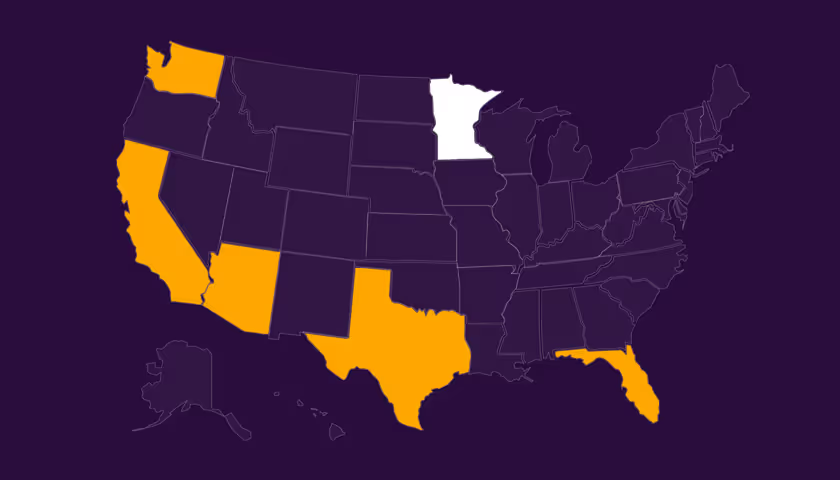
Estimate a long-distance move →Looking to ship your car to another state or across the country? Rivalane arranges transport between Minnesota and all 50 states. Select a state to see what shipping that route involves.
The list below is weighted toward the Twin Cities for a reason. Seven counties around Minneapolis and St. Paul hold more than half of Minnesota's population, which is why most pickup and delivery points here are metro suburbs rather than the two core cities themselves. Rochester, Duluth and St. Cloud are the exceptions worth naming, and we arrange transport to addresses well beyond all of them.